
The Army has ‘owned the night’; now it must own the electromagnetic spectrum
During the wars in Iraq and Afghanistan, the US Army benefited from an enormous advantage in night-vision technology — an advantage captured in the phrase “we own the night.” Retired Maj. Gen. Jefforey Smith argues that commanders now need to bring a similar mindset to electromagnetic spectrum operations (EMSO), where the ability to sense, communicate, maneuver and survive in a contested spectrum increasingly determines battlefield advantage.
Smith, market development executive for the US Army and USSOCOM at Silvus Technologies, spoke with Breaking Defense about how the electromagnetic spectrum is changing warfare, what commanders need at the tactical edge, and why resilient communications increasingly require multiple layers of electronic warfare protection.
Breaking Defense: From your perspective as a former Army commander, how has the character of warfare changed?

Smith: When I commanded a brigade in the 82nd Airborne Division during Operation Iraqi Freedom, we operated in what, by today’s standards, was a relatively permissive electromagnetic environment. There were emerging electronic warfare threats, particularly associated with the counter-IED fight, but we did not face anything approaching the scale and sophistication of the spectrum threat that commanders must prepare for today.
Our tactical communications were relatively straightforward: SINCGARS, point-to-point communications and, when available, satellite communications. We were not connecting anywhere near the number of sensors, unmanned systems, vehicles, command posts and individual Soldiers that we’re connecting today.
That has fundamentally changed. Today, virtually everything on the battlefield is connected—and everything that is connected creates both opportunity and vulnerability. Soldiers, sensors, vehicles, unmanned systems, weapons and command nodes are constantly producing, consuming and transmitting data across the electromagnetic spectrum.
That connectivity gives commanders extraordinary situational awareness and lethality. But it also creates an electromagnetic signature and a much larger attack surface. An adversary can potentially detect it, characterize it, geolocate it, disrupt it and ultimately use it to target the force.
For decades, the US military talked about how we “owned the night.” Everybody understood what that meant. Our night-vision capability allowed American forces to see, maneuver and fight in conditions where our adversaries could not compete effectively. I believe we need to approach the electromagnetic spectrum with that same mindset.
We have to own the spectrum. That doesn’t mean the spectrum will be uncontested. We should expect adversaries to transmit, interfere and actively challenge our ability to operate. Owning the spectrum means having the technology, training, tactics and operational understanding to see the spectrum, survive in it, maneuver through it and exploit it faster than the adversary. If we cannot do that, we should not assume that the network—or the decision advantage it enables—will be there when the shooting starts.
What does a commander specifically need to “own” in the electromagnetic spectrum?
I think it comes down to three things: awareness, resilient connectivity and adaptability.
First, commanders need spectrum awareness. You cannot effectively maneuver through an environment you don’t understand. We wouldn’t send a commander into terrain without a map or intelligence preparation of the battlefield. Increasingly, the same principle applies to the electromagnetic environment. Commanders need to understand what is happening around them: Where is the spectrum congested? Where is the interference? What is friendly? What may be adversarial? What is changing? And, most importantly, what does that mean for the mission?
Second is resilient connectivity. The bandwidth demands of modern formations are enormous compared with what we experienced 20 or 30 years ago. We’re moving full-motion video, position-location information, sensor feeds, targeting information, voice and command-and-control data across formations that are increasingly distributed and constantly moving. That information has to continue flowing while the force is on-the-move, dispersed and under electronic attack.
The third requirement is adaptability—and that includes controlling your RF signature. Commanders increasingly have to ask: Who can see my network? Who can hear it? Can they locate it? And how quickly can they turn that information into targeting data? That is why low probability of intercept/low probability of detection—LPI/LPD—matter so much. Connectivity is only an advantage if you can maintain it without unnecessarily exposing the force.
This is where software-defined mobile ad hoc network radio technology becomes increasingly important. With Silvus StreamCaster MANET radios, capabilities can continue evolving through software and firmware updates rather than requiring an entirely new hardware architecture every time the threat changes. Powering StreamCaster MANET radios is Silvus’ proprietary MN-MIMO waveform that provides a resilient communications foundation. On top of this foundation, we’ve built additional capabilities to reduce the radio’s RF signature, maneuver away from interference and mitigate electronic attack.
The key point is that EW resilience begins before the jammer turns on. If I can make my network more difficult to detect, characterize and geolocate in the first place, I’ve already complicated the adversary’s kill chain.
Why is avoiding detection so important in a contested spectrum?
Because today, every transmission can become a targeting opportunity. For much of the counterinsurgency era, commanders were primarily concerned with whether communications worked. Today the question is broader: Can the enemy detect it, can they locate it, and what can they do with that information?
Every transmission contributes to an electromagnetic signature. A capable adversary may be able to detect that signature, geolocate the source and feed that information into a targeting process. LPI/LPD isn’t simply a communications issue. It’s a survivability issue.
That is especially important for command posts, dismounted formations, reconnaissance elements and other units that depend upon remaining difficult to find. This is where resilient communications and Silvus’ Spectrum Dominance suite of EW defenses come together.
MANET Power Control, or MAN-PC, for example, dynamically adjusts transmit power to the minimum amount required to maintain network connectivity. Instead of transmitting at unnecessary power levels, the network reduces its RF footprint wherever conditions permit.
Wake on Wireless takes that concept further by allowing StreamCaster MANET radios to remain RF silent while still receiving mission-critical information, without emitting even routine control traffic that could reveal their position. Consider the operational implications: a dismounted element could receive ISR information from an airborne unmanned system while minimizing its own RF emissions and reducing the risk of revealing its position.
The broader principle is straightforward: If the enemy can’t detect you, they have a harder time finding you. If they can’t find you, they have a harder time targeting you. That’s why signature management has to become part of how commanders think about tactical communications.
Resilient communications are foundational. What needs to exist around the waveform to keep communications functioning under electronic attack?
I think of the MN-MIMO waveform as the nucleus of the network. It has to be resilient from the beginning, but the waveform alone isn’t enough. No single anti-jam technique is going to defeat every threat. That’s why you need layers of protection and multiple options that allow the network to respond differently depending on what is happening in the electromagnetic environment.
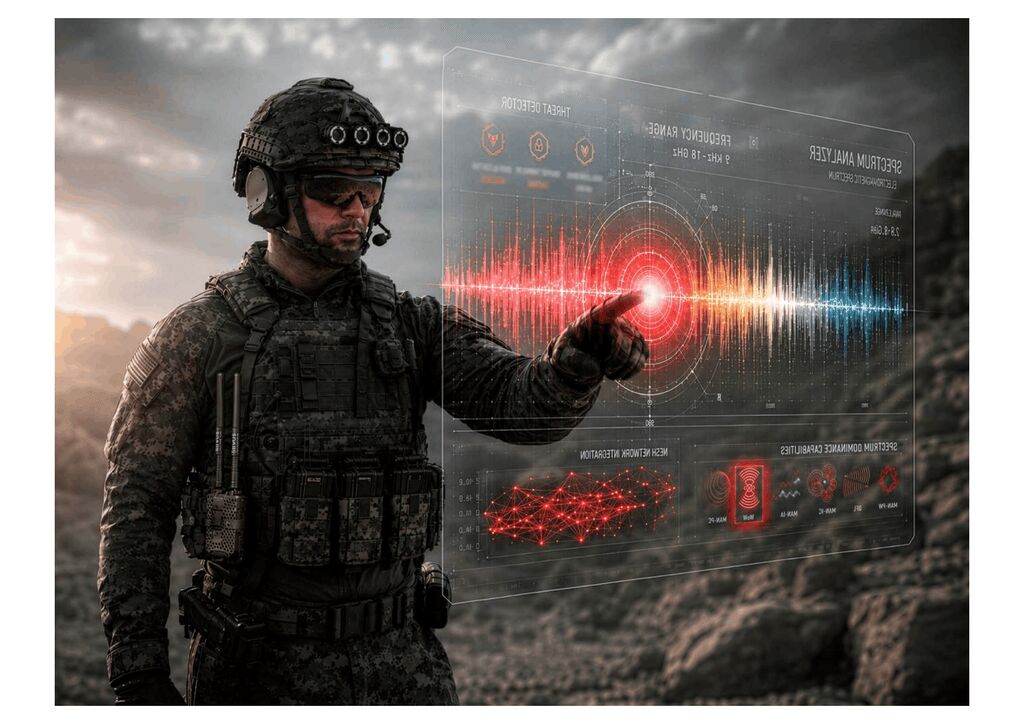
That’s the approach behind Spectrum Dominance 2.0. StreamCaster MANET radios incorporate real-time spectrum monitoring through their built-in MANET Spectrum Analyzer. That provides awareness of interference conditions and gives the network and the operator information needed to respond. From there, different threats can require different anti-jam techniques.
Dual Frequency Link provides frequency diversity by allowing radios to transmit on one frequency channel and receive on another, making the network more resilient to jamming across multiple concurrent frequencies. MANET Interference Avoidance, or MAN-IA, enables the network to identify interference and dynamically move to a cleaner frequency without requiring the operator to manually reconfigure every radio. MANET Interference Cancellation, or MAN-IC, takes another approach. It characterizes the interfering signal and uses spatial processing to suppress that interference while preserving network connectivity.
These capabilities address the problem differently, and that’s important. There is no silver bullet in electronic warfare. A sophisticated adversary will change techniques, frequencies, power levels and tactics. The network therefore has to be capable of adapting as quickly as the threat does.
The objective isn’t merely to survive one particular jammer. The objective is to give commanders multiple layers of resilience and multiple courses of action so the network can continue supporting the mission as the electromagnetic environment changes.
And the challenge is doing that without forcing the commander to choose between EW resilience and operational performance. Warfighters still need range, throughput, mobility and network robustness while these protections are operating. That’s ultimately what we’re delivering with Spectrum Dominance: advanced EW defenses that enable the network to maintain mission-critical performance under electronic attack – preserving freedom of maneuver in the electromagnetic spectrum.
What else should commanders understand about electromagnetic spectrum operations?
From my perspective as a practitioner of warfare, we have to operationalize the spectrum. It’s similar to the way we learned to operate with night-vision goggles. Putting NVGs on a Soldier didn’t automatically make that Soldier more effective at night. You had to train with them. You had to understand depth perception and their limitations. Leaders had to learn how formations moved, fought and commanded differently at night.
Eventually, operating at night became part of our culture. It became second nature. That’s where we need to go with EMSO. The challenge is that the electromagnetic spectrum is invisible. A Soldier can’t see RF energy the way he can see a ridgeline, road intersection or enemy vehicle. Because it’s invisible, it’s easy to treat the spectrum as something belonging to signal officers or electronic warfare specialists.
It isn’t. It’s the commander’s business. Commanders need to understand their electromagnetic terrain just as they understand physical terrain. They need to understand their signatures. They need to know how their networks behave under attack. And their units need to train in contested spectrum environments until operating through interference and electronic attack becomes routine rather than exceptional.
We have to make the invisible visible. That means giving Soldiers and commanders the tools to understand, visualize and maneuver within the electromagnetic environment—and then incorporating that understanding into training, planning and tactical decision-making. The force that can do that faster than its opponent creates a powerful advantage.
Ultimately, nearly every modern military operation depends in some way on access to the electromagnetic spectrum—from sensing and communications to navigation, targeting, unmanned systems and command and control. Spectrum superiority isn’t an abstract technical objective – it’s about preserving freedom of action.
It’s about giving warfighters the awareness, resilient connectivity and freedom to maneuver they need to understand faster, decide sooner and act decisively.