
Ex-defense minister’s futuristic ‘Army of Robots’ raises eyebrows in Ukraine
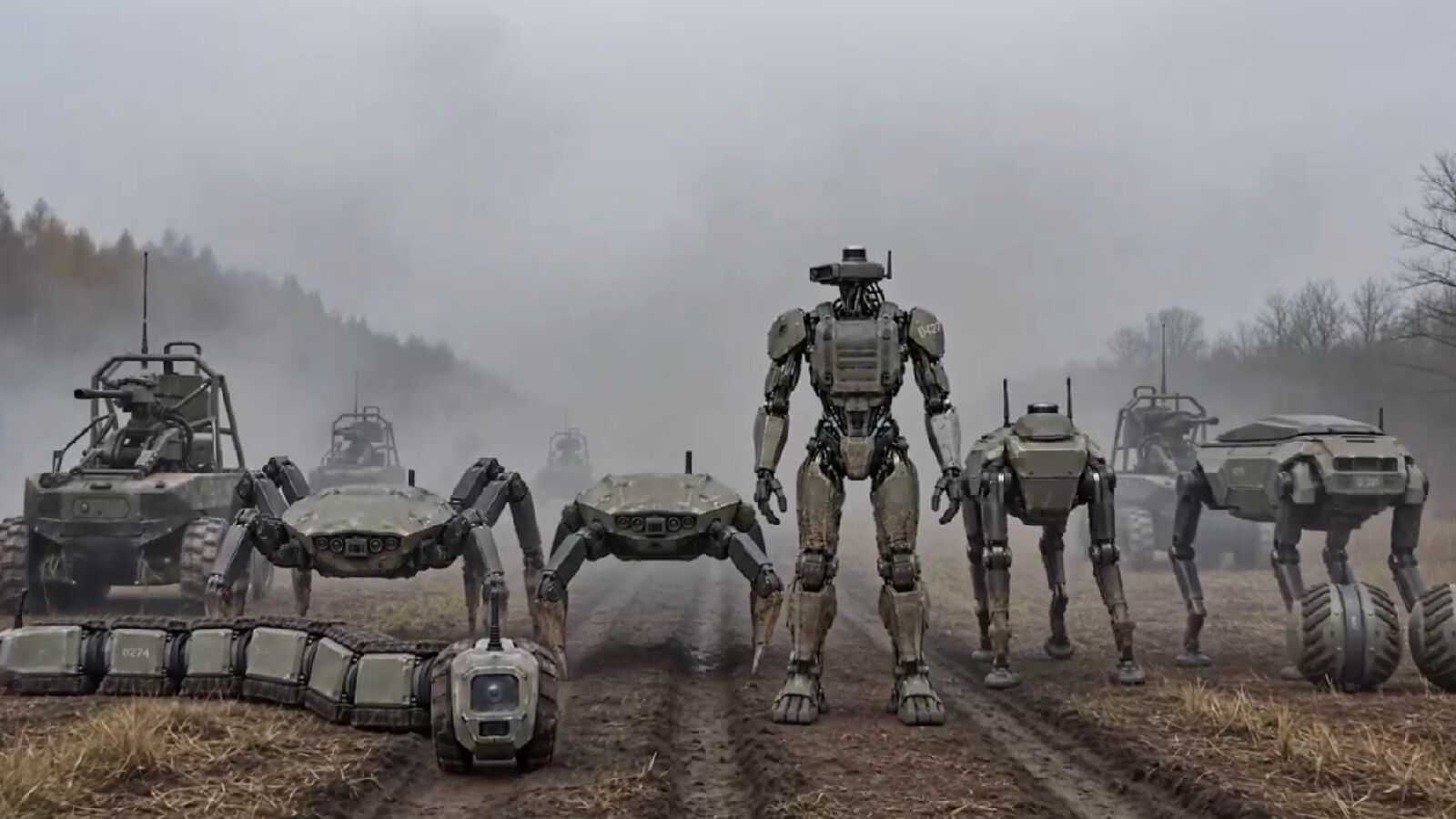
LVIV, Ukraine — Ukraine’s former Minister of Defense Mykhailo Fedorov has launched a new project to build a robotic army, including humanoid soldiers, intended to largely replace soldiers on the battlefield.
He contends the initiative will “save lives,” but it has also sparked mixed reactions at the IT Arena conference here and beyond.
During the conference, which took place here from Sept. 25-27, Fedorov, who was controversially dismissed in July by Ukraine’s President Volodymyr Zelenskyy, unveiled an envisioned “Army of Robots” with a sleek, CGI video showing humanoid robots aiming rifles, fighting in trenches, and marching in a massive formation.
“In 2022, we launched the Army of Drones. […] Today, drones account for more than 95% of strikes,” Fedorov said in a social media post on Sept. 26. “But technological warfare does not stand still. We need the next breakthrough. Our bet is on the robotization of warfare. The mission of the Army of Robots is to save lives.”
During his conference speech, he explained that the future battlefield he envisions would be one where sensors detect threats first, followed by the deployment of robots, based on the belief that robotic platforms “should fight instead of people.”
Fedorov announced in August that he was launching his own defense company, with few details about what it would entail, except that its first major investor would be Palantir CEO Alex Karp.
In his speech here, Fedorov did not say what role his company would play, but emphasized that his vision would not be supported by one single company anyway. Rather, he saw an “ecosystem” that will involve investments in defense companies, R&D capabilities, testing alongside the military and scaling of effective systems.
Fedorov also outlined an ambitious goal: achieving the first “confirmed battlefield result using a humanoid robot” within six months — in other words, the first enemy kill carried out by a two-footed robot during this timeframe. Over the next 12 months, under this initiative, the army of robots is further expected to conduct “an assault operation,” during which the robotic platforms will execute the deadliest parts of the mission independently of infantry.
The idea of humanoid soldiers is as old as science fiction, but technological advances have put working models within reach like never before. Earlier this year, China hosted a robotic Olympics, featuring humanoid bots performing superhuman feats (and also crashing spectacularly). The US Army appears interested in the technology, hosting what it called the xTechHumanoid competition earlier this month to explore how “emerging commercial humanoid technologies could contribute to future military operations.”
At the event here, however, the project launch met mixed responses. Borys Drozhak, founder of Ukrainian unmanned ground vehicle (UGV) manufacturer Rovertech, questioned the practicality of humanoid robots in particular.
“Our main goal at Rovertech is not to make the best UGVs ever, but to make the best possible outcome for our country. That requires making technologies that are easy to scale and fast, that should be cheap and last as long as possible on the battlefield,” Drozhak said. “I hope Fedorov knows exactly how to handle the mathematics of war with his new project, but if you go to humanoid robots, these elements are harder to achieve, especially when considering that the chances that something might go wrong when you go on two feet rather than on wheels are higher because it is more unstable and much costlier.”
Tracked or wheeled UGVs have played a central role in a wide variety of missions across the Ukrainian battlefield over the last few years, from rescuing wounded soldiers to now being used as a strike platform. However, they are not frequently used in fully autonomous mode, generally relying on Starlink to connect to a human operator.
In contrast, as of 2026, fully humanoid robots have never been deployed in active military combat, making their effectiveness hard to assess. Fedorov’s press team did not respond to a request for comment for this report.
Another Ukrainian official who said she was taken somewhat off guard by the new project is Kateryna Chernohorenko, former Deputy Minister of Defense for Digital Transformation of Ukraine from 2023 to 2025. She worked closely under Fedorov for several years and was a key member of his reform team at the Ministry of Digital Transformation from 2019 to 2023.
“It was a surprise for me, the launch of this project. What has been proposed is a difficult endeavour. It is not exactly the same model as building an army of drones, which we managed to achieve successfully,” she told Breaking Defense in an interview on the sidelines of the conference on Sept. 26.
Beyond the tech itself, Chernohorenko explained, the main challenge in accomplishing this project is having the right environment and structures in place.
“If we speak about an army of robots, we talk about the training of operators, which should’ve started yesterday. You need to have the suitable infrastructure and coordination centers in place yesterday to support this,” she added.
She added that while she is not skeptical that Ukraine can build such systems, given the country’s highly proficient R&D and engineering base, she does not necessarily view them as the most urgent need for the war-torn country over other, more urgently needed weapons.
“I think we need to have priorities, and for me that would be cheaper cruise missiles. I think this year will be the year of cheaper cruise missiles and air defenses, as Russia is much more vulnerable to these. If we speak about air-land-economy, the strategy of our army, they need to have, firstly, cheap cruise missiles over [humanoid] robots,” Chernohorenko said.
Chernohorenko warned that scaling production of these types of robots would be more challenging than first-person-view drones, for instance.
“We need to have a component supply chain base for these platforms as well,” she said.
Federico Borsari, a fellow with the Transatlantic Defense and Security Program at the Center for European Policy Analysis, suggested that Fedorov’s latest project also needs to be considered in the context of his dismissal from his previous function at the MoD.
“Announcing such an ambitious project was a way to draw attention to his work and signal that he remains an influential player in Ukraine’s economic and political landscape — he likely seeks to develop a technology that can be dual-use and have market prospects beyond defense,” Borsari said.
From a military perspective, the analyst concurred with Drozhak and Chernohorenko that Ukraine needs validated, reliable robotic platforms that are easy to use and can be quickly repaired or upgraded.
He added that while humanoid robots may play a role on future battlefields, he sees this as a distant prospect, largely because militaries lack the doctrines or frameworks to use them.
“To put this into perspective, most countries are still figuring out how to adjust and develop doctrines for the current generation of uncrewed systems, after four years of intensive use. … As Chernohorenko said, Ukraine [instead] needs prompter, longer-range effectors and cheaper cruise missiles to engage Russian targets in depth,” Borsari said.