
Navy, Shield AI pour big bucks into X-BAT drone development
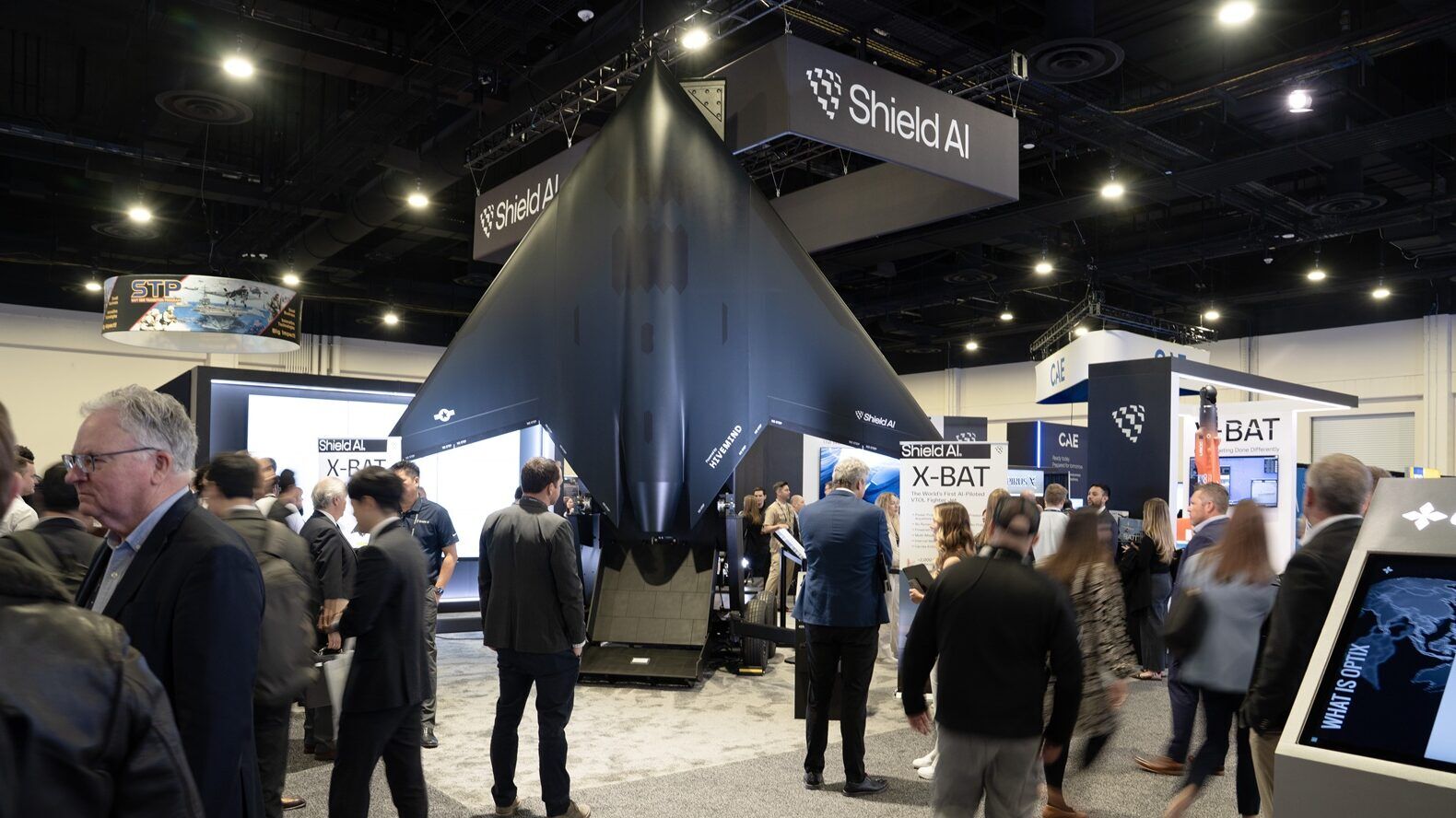
WASHINGTON — Artificial intelligence startup Shield AI and the Navy are putting another $300 million into the company’s X-BAT vertical takeoff and landing (VTOL) drone, the firm announced today.
The Navy has signed off on a $150 million modification to an existing Other Transaction agreement for the X-BAT program under the Pentagon’s Defense Exportability Features program, and Shield AI has agreed to match that funding with $150 million of its own capital, according to the firm.
The investment builds upon another $100 million in government and private funding announced. In August, the Navy’s Portfolio Acquisition Executive (Aviation) Rapid Capability Cell and the Defense Innovation Unit (DIU) awarded $50 million in funding for the X-BAT program as part of the Runway Independent Maritime Expeditionary Strike (RIMES) effort, which seeks a drone capable of conducting long-range strikes with minimal infrastructure. Shield AI also coupled $50 million in private capital to match government funding for that initiative.
Altogether, Shield AI and the US Navy are investing a combined $400 million in the X-BAT drone, which is slated for flight testing later this year.
“We are testing early and often while working on the aircraft, mission systems, ship suitability and production in parallel,” Armor Harris, senior vice president of aircraft at Shield AI, said in a statement. “That approach helps us identify and resolve issues earlier, reduce development risk and move more quickly toward flight testing.”
After unveiling X-BAT last year, Shield AI announced last month that the Seattle area would serve as the production site for the aircraft while testing would occur at the Newton City-County Airport in Kansas.
The firm said that it has employed 500 engineers at Shield AI and other “key suppliers” to construct a test aircraft and has already completed engine light-off and thrust-vectoring nozzle integration. The aircraft — which Shield AI markets as the “world’s first AI-piloted VTOL fighter jet” — measures in at 26 feet long with a 39 foot wingspan and a range of more than 2,000 nautical miles, according to the company.
The effort comes as the Navy has sought an unmanned aerial system (UAS) capable of launching from ships without large flight decks — like Arleigh Burke-class destroyers — to conduct long-range strikes.
The DIU published a solicitation in February for the RIMES program, which claimed that naval surface combatants are “constrained in their ability to support long-range strikes over extended combat operations due to reliance on single-use missile systems, with limited magazine depth and limited at-sea munition replenishment capability.”
As a result, the notice said the Navy wants a drone that can launch from “expeditionary locations with minimal infrastructure, or from ships without large flight decks,” and have a one-way range of at least 1,400 nautical miles with 1,000-pound munitions.
JJ Cummings, Shield AI’s head of mission solutions for the US Navy, touted the aircraft’s design for the Navy operations.
“Its runway-independent design and small deck footprint can increase sortie generation and extend long-range air combat power from CVNs, LHAs, LHDs and ESBs,” Cummings said in a statement. “Just as important, we are designing it for safe, high-tempo manned-unmanned flight deck operations and integration with the missions and capabilities of the carrier air wing, so X-BAT can add combat power without compromising existing operations.”