
Power at the sprocket: It’s the transmission that gives tracked vehicles their control
Ground combat vehicles such as the Bradley Fighting Vehicle have run out of room to add new capabilities, while the next generation will need to power not only what is built into them from the start, but what’s to come over the lifespan of the vehicles.
Improved power generation and efficiency will be critical to ensuring troops can rely on the capabilities they need from their vehicles. Breaking Defense spoke with SAPA Transmission President Maj. Gen. (Ret.) Darren Werner, former commanding general of US Army Tank Automotive and Armament Command (TACOM), and John Tasdemir, vice president of engineering and operations, about the company’s transmission technology and how SAPA is helping to revitalize the US defense industrial base.
Breaking Defense: What is driving the need for new transmission technologies in military vehicles?

Werner: Current military vehicle transmission technology was designed and developed in the early 1980s to support heavy combat systems. Those designs were built around the drivetrains, engines, and mission requirements of their time. Legacy transmissions performed well for the requirements they were designed to meet, but today’s combat vehicles face very different demands. Manufacturing, design, and engineering are now digitally enabled, creating opportunities to increase efficiency, adaptability, and growth potential in systems designed and built for the future.
If you look at the history of ground combat systems, and specifically where John used to work at GVSC (US Army Ground Vehicle Systems Center), Army technical assessments in the early 2000s identified emerging propulsion gaps in transmissions and engines. In practical terms, there had been limited incentive to invest capital in redesigning systems that were still functioning. As a result, engine and transmission technology remained largely unchanged for decades while vehicle weight, power demand, and mission complexity continued to grow.
The Army recognized that lack of development and started to incentivize companies to look at better alternatives. SAPA took advantage of the Army’s desire to find a better solution and started working on developing a solution that was more in line with what the future requirements. The introduction of the XM30 advanced infantry combat vehicle is an important example of where this technology is going. XM30 is being developed around the Army’s need for greater growth capacity, improved mobility, advanced electronic systems, and future autonomy. Those same drivers also apply to legacy platforms. The advantage of a more efficient, software-centric, drive-by-wire capable powerpack is that it creates a path to upgrade existing combat vehicles without redesigning the entire platform. In many cases, replacing the powerpack with an advanced engine and transmission solution can restore mobility, increase usable power at the sprocket, reduce thermal burden, and provide the digital control foundation needed for future capabilities. That gives the Army a practical way to modernize legacy fleets while also introducing next-generation performance into new platforms like XM30.

Tasdemir: As vehicles are growing, vehicle capability is growing. We always talk about ‘what does the future next generation of combat vehicles look like?’ There are more protection systems, more electronic sensors, more weapon systems, more autonomous drive requirements. But now you need to improve the vehicle’s overall propulsion system, better efficiency, better thermal management, power distribution as we develop hybridization. Those are the challenges the Army felt back in the early 2000s timeframe. What can we do on the mobility side now that we’re adding all the capabilities on the operation of the vehicle? How do I get that vehicle to be faster and to enable it to grow as the vehicle gets heavier for current platforms and for future systems?
The Army always uses SWaPC, size, weight, power and cooling. What can you replace while also maintaining and supporting those future and current vehicles applications? The architecture that SAPA has, our 32-speed transmission architecture, allows for that scalability and modularity across multiple vehicle classes from ranges of 35- to 75-ton applications and to adapt with newer emerging propulsion systems in the future.
Hybridization and electrification are being enabled on current and new platforms today. SAPA can adapt to those systems, as well, without having to do a major redesign of the vehicle. What can you do on the current platforms to minimize the integration impact and the design aspect of it with the aim to increase mobility? And for new vehicles, what can you do above and beyond? SAPA’s architecture is focused on a compact, power dense design with high efficiency to minimize space on the vehicle and maximize vehicle power and performance.
How does your transmission accomplish those goals? What makes it unique?
Tasdemir: We don’t have a torque converter. The 32-speed transmission architecture allows us to not include a torque converter. Typically on vehicles, ground or track vehicles – and in automotive, as well – the torque converter is the most inefficient point, but it allows vehicles to do better at climbing hills or launch assist.
The 32-speed allows us to remove that torque converter and provide purely mechanical gear shifting. That is where it’s the highest efficiency as compared to a torque converter. Torque converters range from down to 65 percent, 70 percent up to 80 percent, whereas the mechanical systems are 90 percent or greater. SAPA’s transmissions operate at greater than 90% efficiency.
That allows us to reduce power usage and create a lower thermal burden for the vehicle, as well. We also have a fully drive-by-wire integrated system as our inherent design. Our steering and braking functionality are all compact with that architecture that offers a fully teleoperational function for vehicle OEMs.
Werner: SAPA transmissions are software centric. What that means is that it enables the customer, the US Army or the US government, to have the flexibility to adapt and change the characteristics of the combat platform just by making a software change.
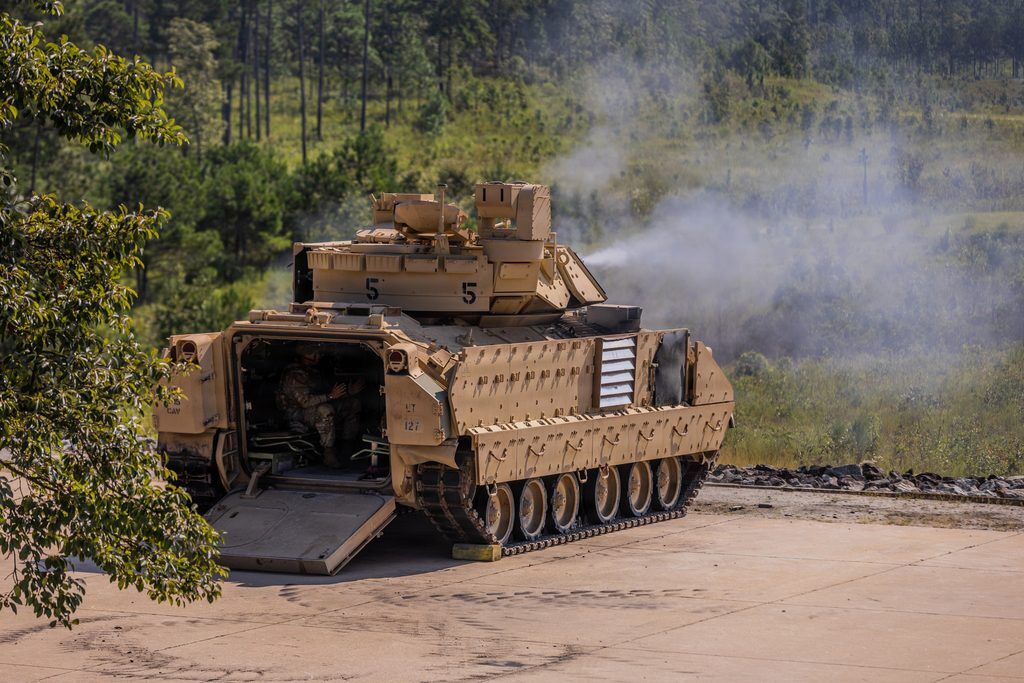
The best example I can use is in combat in 2003, I was a part of an organization that had Bradleys. When the Bradleys deployed into Iraq, they didn’t have reactive armor tiles, but soon after we arrived, we started to receive kits of reactive armor tiles to install in the Bradleys. It was great because reactive armor is a great way to defend against different threats, especially rocket-propelled grenades. We wholeheartedly got those tiles loaded up and installed on those Bradleys.
The impact of adding significant weight to the Bradley was that the vehicle lost mobility. It no longer accelerated the way it needed to. It experienced degraded power delivery and other performance issues because the transmission was not designed to move a Bradley with that additional weight.
With our transmission, software changes can adjust shift schedules and control logic within the mechanical design envelope, allowing the vehicle to respond better to changes in weight, configuration, or mission profile. The drive-by-wire capability strengthens that advantage because steering, braking, and transmission control are integrated through the same digital architecture. That means the vehicle can translate operator commands into more precise, software-managed mobility responses, giving the platform greater maneuverability, smoother control, and a more adaptable path for future autonomy, teleoperation, and advanced vehicle functions. That adds an important operational advantage because the customer does not have to replace the entire hardware system to make targeted performance adjustments. It is an element of our transmission that leaders in the Army and across industry recognize as a benchmark for mobility.
In your example, with the reactive armor and adding weight to the vehicle, what can you change via software that allows it to carry another ton that it was never designed for in the first place?
Werner: It’s in the design of the transmission. John talked about 32 gears. Now what you have is a broader scope of gearing that you can transfer the load into. Instead of shifting at X RPMs, you can shift at Y RPMs and it can get the vehicle accelerating quicker.
It’s just like in your car. If you have ever driven a manual transmission and you shift consistently, you can get the vehicle going pretty quickly. But if you put it in first gear and let it stay in first gear and try to get it up to 50 miles an hour, you’re never going to get there. This enables you to shift at a rate that’s consistent with what the different physical nature is of the platform after it’s been changed.
How did you remove the torque converter? How does that work in practice?
Tasdemir: All transmissions have a mechanical element to them. You have your shifting gears, you have either an eight-speed, or five-speed transmission, while SAPA offers a 32-speed design. The torque converter is on the front end of it. We remove that torque converter. The 32-speed design, using the software and the digital controls, enables use to function the entire range of vehicle operations.
Our architecture offers a greater ratio coverage of 20:1. We don’t start at gear one and work all the way up to 32. Depending on the vehicle application, you start at, say, 13 speed and you allow shifting upward to accelerate. If you need to climb a hill, you go downward depending on which ratio you need to be at. Our transmission systems enables almost continuous gear shifting without power interruption using lower average engine speeds, thereby extending the life of the powertrain.
You describe your transmission as power- and engine-agnostic. What does that mean for efficiency and capability in the field?
Werner: You can see the energy losses associated with heat generated by a transmission that uses a torque converter. That heat represents energy that is not being delivered as usable power to the sprocket.
When we say engine-agnostic, we mean the transmission is designed to maximize usable engine output by transferring more available power efficiently to the sprocket, rather than losing energy through a torque converter. Over the last several years, we have worked with engine manufacturers that support the US defense industry and integrated our transmission with multiple engine families. That work has produced an array of transmission configurations with different exterior profiles to support the engines and vehicle platforms in use today.
For example, our ACT850 has multiple designs that support different engines. The ACT1075 follows the same approach. Using digital design and engineering, we can rapidly develop transmission profiles that support the outputs and configurations of different engines. That gives customers flexibility to pair the transmission with a broad range of engine and vehicle configurations. A further advantage is the ability to move toward common transmission architectures across the Army’s tracked combat vehicle fleet. Common transmissions can reduce the number of unique parts in the supply system, simplify maintenance procedures, streamline soldier and maintainer training, and improve readiness by giving units a more consistent sustainment model across multiple platforms. Over time, that commonality can lower lifecycle risk, improve parts availability, and make it easier for the Army to modernize vehicles at scale.
Most Americans associate maneuver and maneuverability with an engine. In tracked combat vehicles the reality is maneuverability, speed, takeoff, braking, all of that is done inside the transmission. The transmission is responsible for taking that power off the engine and making that track maneuverable. When you toss in the drive-by-wire capability along with the software capability, the software management capability, you’ve created a very maneuverable platform.
I did not focus on the engine because its primary role is to generate power. Once the engine produces enough power to move the vehicle, the transmission makes the vehicle maneuverable and turns the power into speed, braking, and maneuverability, making the overall powerpack perform effectively and consequently makes the engine look good.
What do you see going forward and the capabilities needed?
Tasdemir: Where SAPA is looking is how you gain that improvement in efficiency. How much more efficient can I get from my engine to the sprocket, and how much more power can I provide on board electrical power?
Efficiency is a key driver. You can minimize the size of the transmission, minimize the cooling burden of it, and then also provide more power available at the sprocket. Now you have more power available without having to increase the horsepower of an engine, without having to increase the size of the propulsion system. More power at the sprocket allows the vehicle to provide more of a maneuverable architecture in operational mobility and the transmission can modernize current vehicles.
The future battlefield will demand combat vehicles that are more agile, more efficient, more digitally connected, and capable of adapting to technologies that have not yet been fielded. The next generation of mobility systems must do far more than simply transmit engine power. They must intelligently manage energy, support advanced electronics, enable autonomy, integrate new propulsion technologies, and provide growth capacity for evolving mission requirements. At SAPA, we’re engineering those capabilities today so that U.S. and allied forces maintain their mobility advantage for decades to come.
What are the challenges facing the defense industrial base, and how are you helping to solve those challenges?
Werner: The biggest issue with the defense industrial base is age across the board. As the commander of TACOM, I commanded the arsenals, depots and supported ground systems. The arsenals and depots were struggling to maintain their viability and contribute to the defense industry because of the age of the depots and arsenals and the fact that there hasn’t been a very consistent effort to keep them up to current technology.
Even in the private sector, if you look at our foundries, you look at our casting and forging operations across the country, there was a period of time where our government made decisions to encourage offshoring of some operations to other countries where it was economically a better choice to take on offshore-manufactured materials than to manufacture those products onshore. Those decisions that were made stagnated and, in some cases, caused a deterioration of some of the manufacturing skill sets inside of our country.
That offshoring has added a strategic weakness into our defense industrial capabilities. Our strength dating all the way back to World War I and World War II is the ability for us to quickly mobilize and manufacture. We won World War II as a result of our great men and women fighting. But second to that great asset was the fact that we could outproduce any other nation in the world.
Today, the United States does not have the same industrial-base dynamic it once had. Much of the defense industrial base is aged or deteriorated, and there is now a concerted effort to reshore critical technologies, manufacturing, and capabilities that moved offshore in the late 1990s and early 2000s. This is expensive and often requires long lead times, but reshoring can reduce long-term cost, shorten supply lead times and strengthen supply-chain security.
SAPA’s endeavor here in the US supports the administration’s effort to expand domestic defense manufacturing capability. We are building an advanced manufacturing center of more than 200,000 square feet, with eight manufacturing cells equipped with advanced manufacturing tools, multi-axis milling machines, gear manufacturing systems, and automation so we can manufacture using current technology. This expansion not only helps develop the United Stated Defense Industrial Base’s capabilities on shore, but also brings over 200 jobs to the U.S.
If you look out across the US, there’s a lot of new manufacturing that’s standing up to bring in advanced manufacturing technology, whether it’s 3D printed materials, advanced milling materials, and even companies are standing up new casting capability. All that is going to help us revitalize the defense industrial base.