
Weaponizing the supply chain for a liquid-fueled howitzer-fired munition that flies 150 km
Recent conflicts in Ukraine and the Middle East have exposed potential weaknesses in the munitions supply chain, and the defense industrial base is working to ramp up production to meet needs and replenish dwindling stockpiles.
Breaking Defense spoke with Tiberius Aerospace Co-Founder and CEO Chad Steelberg about the company’s efforts to “weaponize the supply chain,” speed up delivery of munitions and develop the systems needed to support the US and its allies.
Breaking Defense: What have recent conflicts revealed about the way the US and its allies develop and replenish weapons?

Steelberg: The human tragedy in Ukraine is central to our ethos as a company, and we used it as a catalyst to understand the challenges that were unfolding in modern warfare. How do you supply weapon systems at scale? What does that network look like?
That ranges from sourcing raw materials, to relying on allies to deliver weapon systems that work, to building up your own military industrial base from scratch. And the RDT&E cycle against your enemy has changed completely. Historically it was measured in years, if not decades, and you fought wars with stockpiled weapons. Now you’re in a tit-for-tat innovation cycle of less than one quarter, right? Every two months you’re watching the weapon systems evolve.
If you can’t iterate it, improve it and get it back in the field, it’s DOA. That is probably the clearest example of how warfare has changed: the RDT&E life cycle now connects directly to the warfighter, and continuous innovation and continuous deployment have become essential to our national security and that of all our allies.
Tiberius calls its approach Defense-as-a-Service. What does that mean in practice?
Look, we’re not just building a better round. We’re defining a new operating model for defense. Defense-as-a-Service means rapid iteration, sovereign scalability and continuous innovation on a global scale. It was one thing to say we’re going to go build amazing products like SCEPTRE and Invictus. But what really mattered was the process behind them: the open architecture.
How do we deliver that on a global basis, and how do we weaponize the supply chain? I use that term very deliberately, because I look at how the commercial world has weaponized supply chains to its advantage. Take Apple: it rolls out hundreds of millions of 700-part iPhones every single year on a brand new design – it weaponizes its supply chain. It doesn’t design its own cameras or LiDAR chips. It weaponizes an ecosystem of suppliers that are constantly innovating.
That’s how we arrived at Defense-as-a-Service, and GRAIL is the software that makes it real. Over the past two and a half to three years, we’ve gone from a concept to saying that we’re not only going to build an exquisite weapon system, we’re going to use GRAIL to actually facilitate its manufacturing, delivery and financing.
Tell us about Tiberius’ $500 million agreement with the UK that puts that model into practice.
This is no longer theory; it’s in practice. We have signed a $500 million manufacturing contract in the UK with a private group that’s building a consortium of manufacturing and RDT&E partners. Most importantly, it means SCEPTRE won’t just be built there – it will be co-developed through GRAIL.
This activity was authorized via a TAA, a Technical Assistance Agreement and AUKUS License Exemption under the ITAR, allowing us to share the co-development of SCEPTRE as the ballistic round moves from TRL 6 to 7 and 8 . That’s federated manufacturing: you qualify the weapon once, then produce it across sovereign, in-country nodes. The UK is the first of those nodes, and the intent is to supply those weapon systems across Europe for European defense.
In my opinion, this is the most important announcement in our company’s history since we first set out our vision of how we’re going to attack defense differently, with Defense-as-a-Service as the business and GRAIL as the operating system that supports it. That was the vision; now it’s reality. It’s been written into a contract, and it’s deployed in the UK.
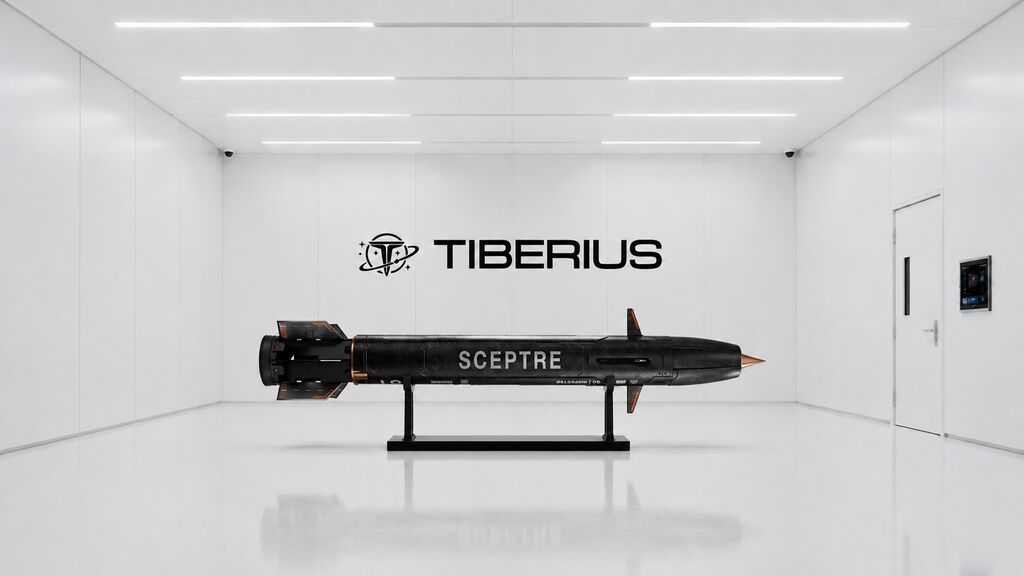
Why did Tiberius decide to build a 155mm long-range ramjet powered precision weapon as its first effort?
We started with the problem. Today you can see further than you can shoot. A drone finds a target deep behind the line, the imagery is on a screen in minutes, and nothing in range can reach it. Your options are all bad: move the guns forward into counter-battery fire, spend a scarce missile, or let the target go.
Then we went to the data. I’m a big AI guy, and we laid the foundation of GRAIL by ingesting every piece of open-source information we could find about every weapon system on Earth. In the process, we started to define a new language for measuring a weapon’s effectiveness. Not just range and accuracy, but target efficiency and the environment you’re shooting in – I’m talking about GPS denial, GNSS denial.
When we ran that problem through the data, the answer that came back was a long-range precision munition designed to strike at 150 kilometers or further, at a specific price point – fired from a howitzer. We looked at that and shook our heads: ‘We’re going to go do what?’ A cannon designed in the 1930s is going to be the best weapon we can build? But it became clear there really was method in the madness. Howitzers are already in service right across NATO. If you can turn the gun the warfighter already has into a long-range precision weapon, you close that gap without waiting for a new platform.
Why power SCEPTRE with a liquid-fueled ramjet engine, and what does that change operationally, such as its ability to throttle?
The reason is fundamental. As soon as you sit down with your engineering team and say, ‘We want to build a long-range precision fires weapon that comes out of a howitzer,’ you have to look at the characteristics of the gun. The gun generates 16,500 Gs. That means anything with moving parts, like a fuel pump, turns into a bag of parts on launch.
Our team took a different approach. We developed a mechanism that allows the liquid fuel and the injection system in the combustor to survive 16,500 Gs, which immediately opened up the opportunity for liquid fuel.
There are three things we like about liquid fuel in our munitions. The first is cost-effectiveness and availability. If you can build a system that runs on anything from diesel and Jet A-1 all the way to JP-10, the weapon’s availability and cost-effectiveness immediately go in your favor.
The second is that we can build munitions that are stored defueled. You can ship what is basically an inert device and stockpile it. Take the payload out and you have just a hunk of metal. From a maintenance standpoint, every 10 years you replace a battery and an O-ring for a couple hundred dollars, and that weapon system is ready to go.
The third is similar to the one you mentioned: not throttling but thrusting. Unlike solid-fueled weapon systems, you have the ability to adjust the thrust curve, giving you all sorts of advantages, not just in survivability, but in weapon effectiveness and terminal performance.
Where does SCEPTRE stand today?
In April we achieved a world first: liquid-fueled ramjet ignition from a NATO-standard 155mm howitzer, with stable flight. We’re now at the TRL 7 tipping point, going through final live-fire tests. To date we’ve been firing at short ranges, making sure we have ignition and proper gun survivability. Starting in October, we move on to longer ranges: full, live, long-distance shots of 150 km-plus, which we’ll be certifying both in the US and overseas. And we film every test, including the ones that don’t go to plan. That’s how you iterate.
Our goal is to complete that certification as early as the end of this year and be ready to deliver final manufactured product in Q1 next year.
Invictus takes a modular approach to missiles. What problem is that intended to solve?
The conventional wisdom on missiles is that you can’t build one that serves multiple missions, because then it won’t serve any mission well. So missiles became so specialized and optimized that they lost the ability to be cost-effective.
The opportunity with Invictus was a strike missile designed for 200 km, with full modularity – components you can mix and match, so it isn’t a do-everything missile, but a modular one. That means you can scale production and reduce operating and manufacturing costs. Suddenly you have a weapon system that can be optimized for different targets and different missions.
GRAIL underpins much of this. Tell us about it.
GRAIL started with GRAIL Effects, our modeling tool. It takes in all the characteristics of both offensive and defensive weapon systems, plus the environmental conditions they’re operating in, and lets you run massive simulations to understand not only their effectiveness, but the cost of that weapon against those targets in those environments.
As we moved into the next phase of our business, we asked ourselves: who’s actually going to help us manufacture our weapon systems? So we built GRAIL Agility, which uses AI to search for and identify vendors and match them against our designs.
The third piece is compliance – import/export rules, ITAR, DSP-5s, MLAs, TAAs. We now have AI systems that draft our manufacturing license agreements fully programmatically, based on the bill of materials and the manufacturing partners.
The final piece was financing – equipment financing and other types – not just for ourselves but for the supply chain we’re now facilitating. That’s where GRAIL Finance was born.
We believe GRAIL is to us what AWS (Amazon Web Services) is to Amazon. We’re building our tools the way Amazon built AWS. Amazon built its cloud because it had problems that no one else had seen, and it started tackling them with software in the cloud. Once that reached a certain scale, they realized what they had built was valuable to the entire ecosystem – which is why AWS is today the most profitable part of Amazon.
We believe GRAIL will hold an equally strong position in the market down range. We’re not trying to force it today; we’re using it internally. But we have now signed hundreds of partners for external systems that aren’t even related to our own products.
We believe that, in 2027, GRAIL will probably become one of the most valuable assets not only to our company, but to national defense.