
Army again tweaks acquisition structure to remove unwanted layer of bureaucracy
WASHINGTON — A year after the Army’s sprawling acquisition overhaul, the service has again realigned the structure of its weapons portfolios, albeit at a much smaller scale, senior service members recently told reporters.
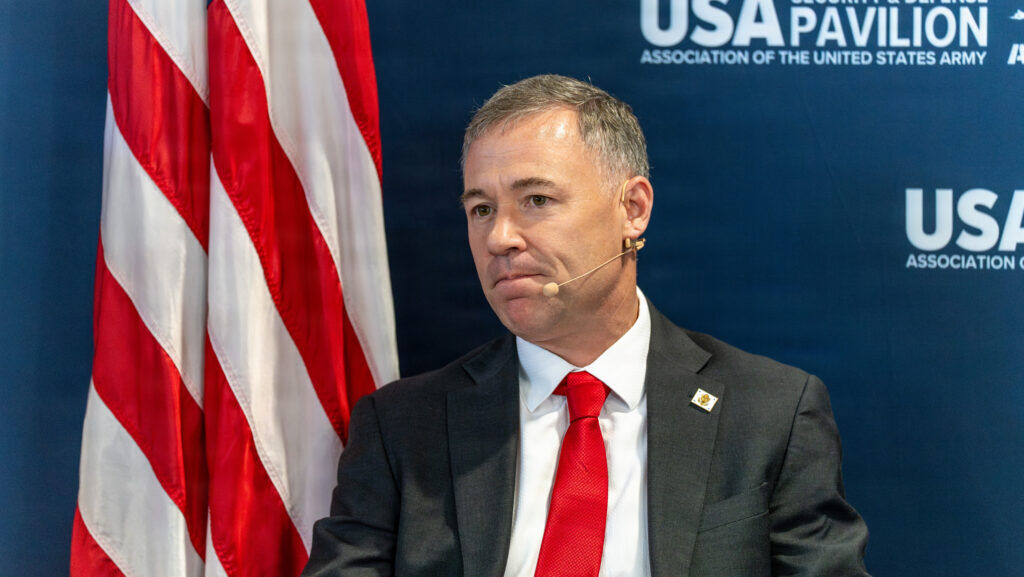
With the new changes, the Army has attempted to remove a layer of bureaucracy between its Portfolio Acquisition Executives (PAEs) and its program managers after Congress ordered it to do so in the 2026 National Defense Authorization Act (NDAA). Brig. Gen. Troy Denomy, PAE for Maneuver Ground, said this will better ensure the acquisition and operational sides of the service are in tandem with each other.
“What’s critically important for the PAEs to deliver for the Army is the alignment, synchronization, and staying closely connected to our operational counterparts,” Denomy said Oct. 8 ahead of the annual AUSA conference “We cannot deliver those formation-based outcomes if we are not tied at the hip and synchronized closely together.”
The adjusted acquisition structure comes nearly a year after the Army underwent a major acquisition reorganization, which consolidated the original 12 Program Executive Offices under the six PAEs for a reduction on the number of general officers at the top rank. The goal: to remove constraints and hone its processes to move much faster.
Under last year’s changes, the Assistant Secretary of the Army for Acquisition, Logistics and Technology (ASA(ALT)), along with the Army’s secretary, would direct acquisition orders down to the Army’s six PAEs and their deputies. The PAEs would then communicate orders down to their Capability Portfolio Executives (CPEs) which then pushed those down to the relevant program managers — the latter being the individuals who most often collaborate with soldiers in the field to see what they need.
However, those changes were rolled out prior to the 2026 NDAA becoming law, meaning the mandates from the legislation were not fully implemented until recently, Ingraham explained.
To meet the legislative guidelines, the Army has removed CPEs from where they formerly lay and placed them to work alongside the PAEs. The purpose of this is to ensure that a specific program is being “managed appropriately on behalf of the PAE” but there is no official reporting structure between them and the program managers, Brent Ingraham, the head of ASA(ALT), told reporters Oct. 8.
The Army also renamed the CPEs to Program Manager Executives (PMEs), Ingraham said.
The PMEs are needed, Denomy said, as they help to keep track of the day to day duties of the program managers and their “enablers” within each PAE, which would be too burdensome a task for one person. For example, he said he has nine program managers under him and each one comes with an “enabler.”
“So 18 direct reports will be very difficult to manage day-to-day. So how do we use and empower the PMEs […] to help with that day to day management?” Denomy said. “In a metaphor that doesn’t follow exactly, but it’s almost like CEO versus COO or CFO from a C-suite perspective. A much similar organization, and it seems to also, when I talk to industry about how we’re organized, seems to resonate with them because it’s very akin to how they tend to organize.”
Another change spurred by the 2026 NDAA was to have all PAEs be “certified acquisition officials.” Prior to this change, three out of the Army’s six PAEs fell into that category and the other three had backgrounds in more of an “operational role,” or served as the heads of the Army’s various Centers of Excellence (CoE), Ingraham explained.
Now, Ingraham said, all deputies come from CoEs or prior operationally-based roles.
“We put requirements, resources, and acquisition authority all under the PAEs, where you can make those decisions in parallel instead of waiting for those sequential handoffs we always had in the past,” Ingraham said. “I can say, one year in this, we can point at real results.”