
US Army, Navy research labs team up to combat Arctic cold
For much of recorded military history, the through line between mission success and failure came down to the basics, including adequate latrine facilities to keep disease vectors at bay.
Despite massive technological shifts, that paradigm still holds, which is why the U.S. Army and Navy have teamed up to keep systems operational — even in the extreme cold of the Arctic.
As the Department of Defense eyes greater operability in the far north, these low temperatures can wreak havoc on equipment and machinery (and toilets), with ice becoming enemy No. 1.
Which is why the Naval Facilities Engineering and Expeditionary Warfare Center, or NAVFAC EXWC, and the Cold Regions Research and Engineering Laboratory, or CRREL, began working with both branches to field a rapidly deployable Triple Container rigid-wall shelter system usable in temperatures as low as -50 degrees Fahrenheit.
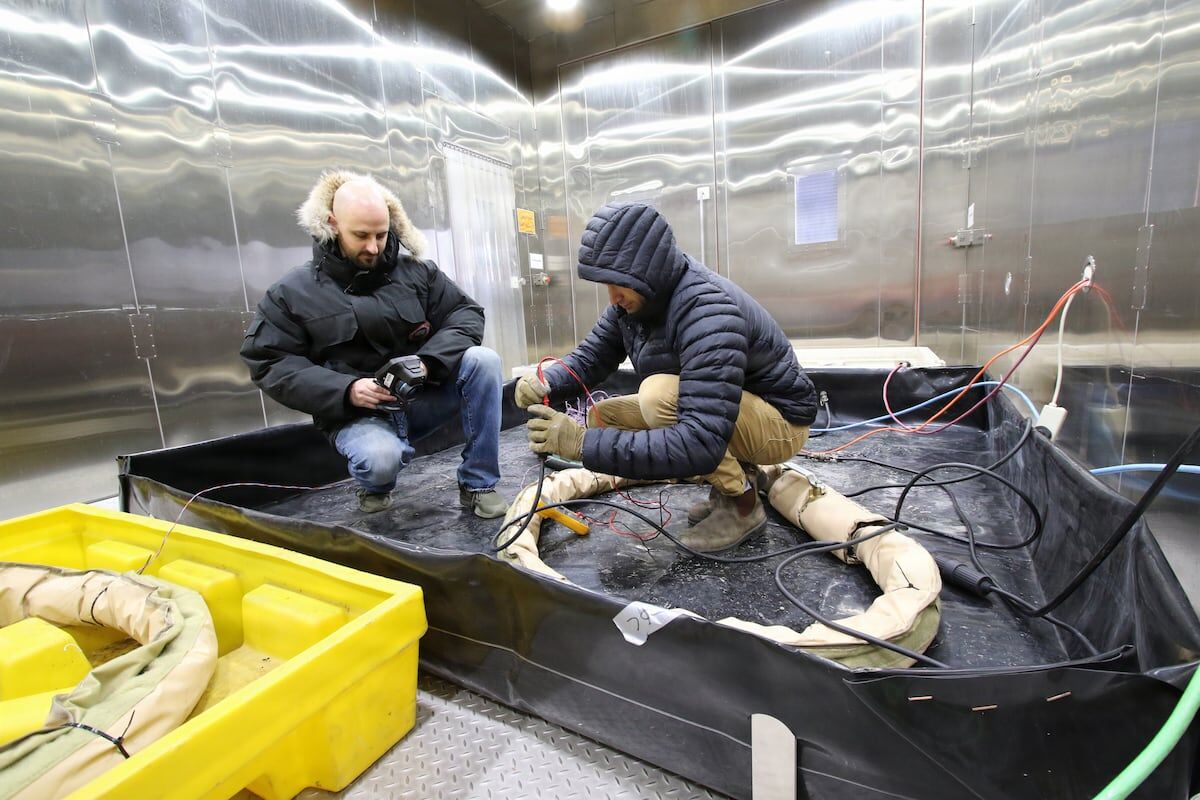
The already fielded version can operate in temperatures as low as -15 degrees Fahrenheit. The team focused on different configurations of thermal wrappings, insulation and other components to ensure that parts of the kit’s components that are particularly vulnerable to cracking and freezing — hoses, valves, bladders and pumps — were able to withstand the greater threshold for cold, according to a recent Army release.
The result, per the release, far exceeded the objectives, with the TRICON-based system staying operational down to -65 degrees Fahrenheit.
Testing took place in CRREL’s New Hampshire-based Extreme Cold Chamber, a 288-square-foot cold room capable of reaching temperatures as low as -90 degrees Fahrenheit, per the release. While military units typically have to wait until the Alaskan winter reaches its peak to simulate similar conditions, the controlled environment allowed the research team to create conditions similar to those of the real world.
“Our armed forces live and operate in extremely cold and difficult conditions, so having these facilities operational is important for their physical and mental health while serving in the Arctic and other high-north environments,” said Dr. Dan Tague, a research chemist at CRREL, one of seven U.S. Army Engineer Research and Development Center laboratories.
In 2024, the DoD released its “Arctic Strategy,” citing “Major geopolitical changes are driving the need for this new strategic approach to the Arctic, including Russia’s full-scale invasion of Ukraine, the accession of Finland and Sweden to the NATO Alliance, increasing collaboration between the People’s Republic of China (PRC) and Russia, and the accelerating impacts of climate change.”
The region, according to the report, had become “a venue for strategic competition,” and a space where the United States intends to build a more persistent presence.
The latest successes with TRICORN-based systems provide, beyond the obvious comforts for personnel stationed in the Arctic — Toilets! Laundry! Showers! — an expanded operational footprint for the U.S. military as a whole, according to James Pilkington, a project manager in NAVFAC EXWC Expeditionary Technical Department.
“This extends the operational range of base camps in terms of geographic locations and durations,” said Pilkington. “In turn [it] extend[s] force posture.”
Claire Barrett is an editor and military history correspondent for Military Times. She holds a master’s degree in military history from King’s College, London, and is also a World War II researcher with an unparalleled affinity for Sir Winston Churchill and Michigan football.