
Forterra partners with Hypercraft on autonomous vehicle for high-risk missions
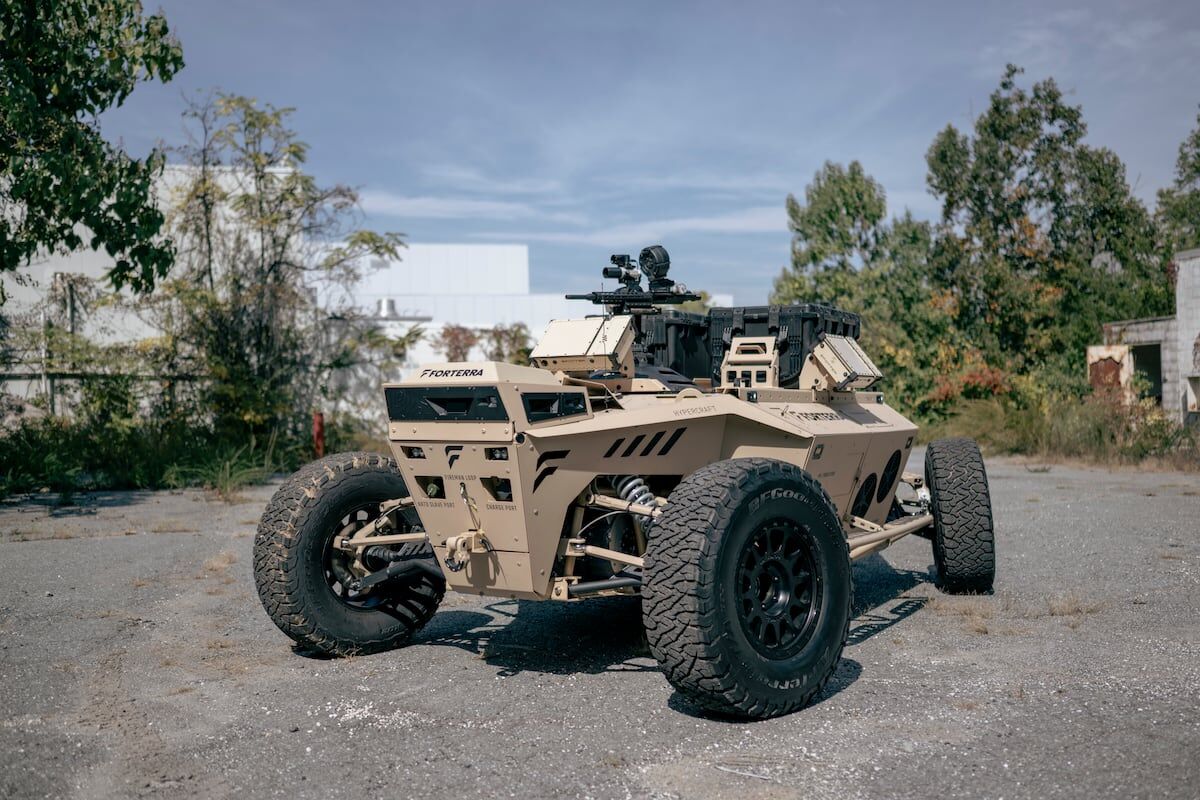
Defense companies Forterra and Hypercraft have collaborated to produce a contested-environment-ready autonomous vehicle, which they showed off for the first time at the Association of the U.S. Army Annual Meeting and Exposition in Washington, D.C.
Forterra installed its AutoDrive autonomy software platform that powers unmanned maneuverability onto Hypercraft’s Razorback ground vehicle, yielding a product that can withstand the punishing logistics of combat without putting soldiers at risk.
“The point of an autonomous military vehicle is to deliver payloads to the point of friction,” Forterra Chief Growth Officer Scott Sanders said. “Razorback has the power, power generation and capacity to carry a wide variety of weapons systems without modification.”
Forterra’s AutoDrive autonomous driving system has become an industry standard, integrated on more than 200 vehicles in active service.
Meanwhile, the Razorback weaponizes 300 horsepower, 4,0000 volumes of payload range, a 500-mile range and up to 38 kilowatts of distributable power.
Forterra was the first U.S. ground autonomy company to be actively deployed in Ukraine and has completed 88 casualty evacuation missions to rescue Ukrainian soldiers from the front lines, according to Forterra spokesperson Kelsey Szablowski.
That mission to not put military personnel in harm’s way is part of Forterra’s mantra.
“Robots don’t bleed,” Szablowski said.
The Army has taken notice of the company’s approach.
In August, the service selected Forterra as a prime contractor for its Engineer Autonomous Breaching Capability program, a larger effort to field autonomous vehicles during mine-clearing missions.
The company outfitted a Ford F-250 with its AutoDrive technology and named it the Mobile Autonomous Uncrewed Lanemaker, or MAUL.
The MAUL, which hosts no human in the driver’s seat and can drive autonomously or be controlled by an operator, is made for reconnaissance, planning and clearing in mine-contested environments.
The autonomous vehicle deploys a rocket-propelled mine-clearing line charge, or MICLIC, to detonate explosives in an area before driving through.
In mid-August, Forterra demonstrated the MAUL’s capabilities during Project Sandhills at Fort Bragg, North Carolina, in which drones attacked the vehicle as it attempted to mine-detect and clear.
The MAUL fought off and destroyed the drones with an onboard automated turret, while it navigated through the area autonomously.
The exercise took place from Aug. 17 to Aug. 28 and demonstrated the Army’s ability to tackle a myriad of mission sets using attributable autonomous systems that reduce risks to soldiers.
“Instead of relying solely on high-value, crewed assets, we can field semi-autonomous F-250s, sUAS swarms and autonomous c-UAS systems that are adaptable, scalable and resilient,” said Capt. Denny Drummey, Sandhills Project operations officer, during the exercise.
Riley Ceder is a Navy reporter at Military Times, where he covers issues directly affecting service members and their families, as well as breaking news.