
Zone 5 ‘found a spot’ in drone interceptor market with new Eclipse: CEO
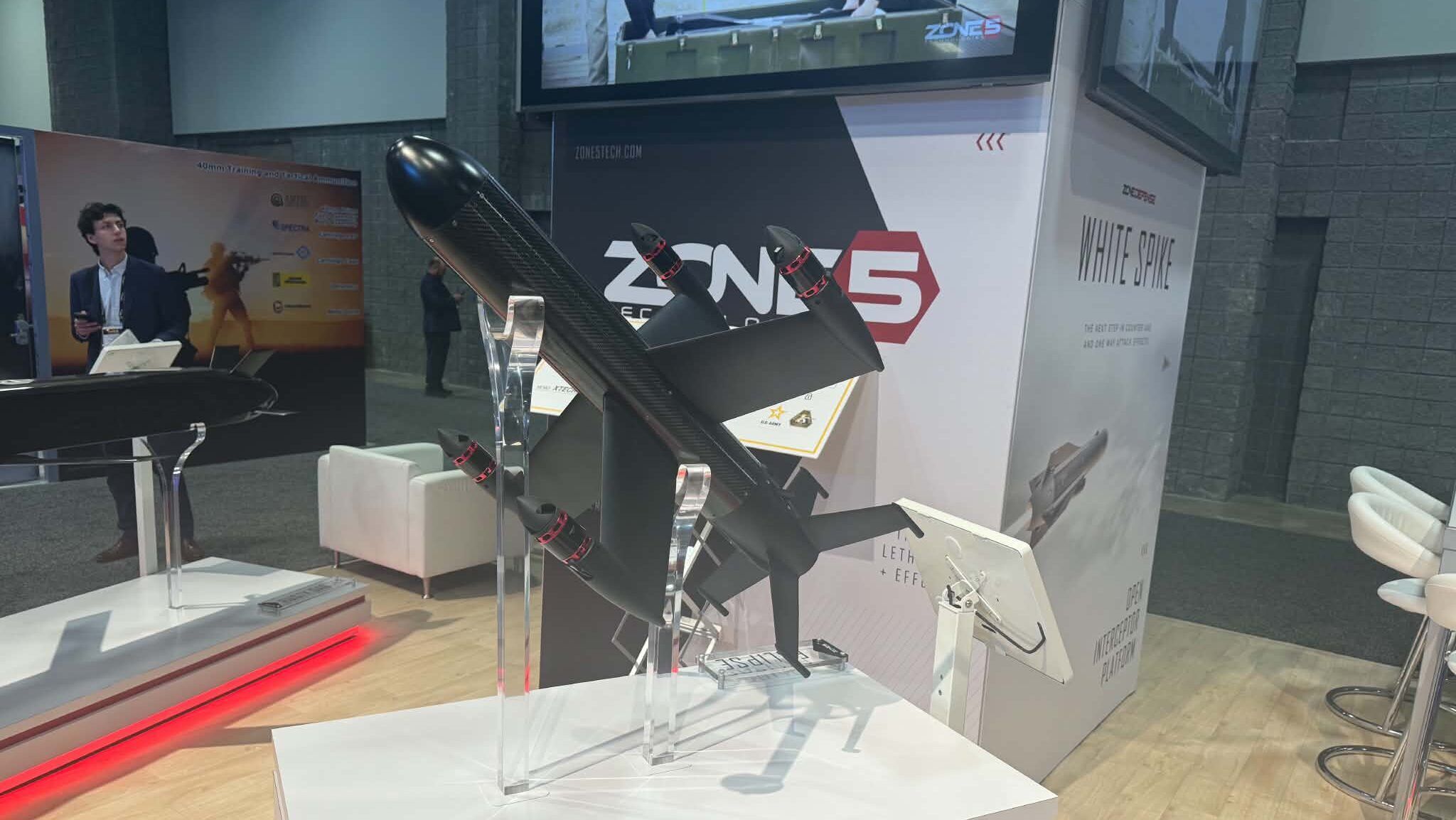
WASHINGTON — Defense startup Zone 5 is joining the rush for counter-drone tech, debuting a new interceptor dubbed the “Eclipse” that the company says can combat high-speed, unmanned threats.
Still in development but shown publicly for the first time at the Association of the United States Army conference here, the Eclipse offers a lower-cost, reusable option to take down high-speed drones, Zone 5 CEO Thomas Akers told Breaking Defense.
Arguing that the market is “coalescing” around smaller interceptors that are in turn challenged by more capable drones, Akers said his firm “found a spot” for a larger interceptor with modular payloads.
Larger doesn’t mean too large — an Eclipse model on display at Zone 5’s booth measured 39 in. long and 32 in. wide. But according to Akers, the platform can sport a high-powered microwave that can zap a drone’s electronics, or can carry a kinetic payload to knock one out of the sky. A company fact sheet said the Eclipse can take off and land vertically, achieve speeds of over 200 knots (230 miles per hour) and reach over 30 miles.
Akers said he expects Eclipse to be in development for roughly another six months before entering production, and is initially aimed at the American market. He said the company is aiming to build hundreds of copies a month but declined to comment on an expected price tag, pointing to various potential payloads that influence a final cost.
Akers explained that the Eclipse helps round out Zone 5’s offerings for layered defenses, from a drone-mounted firearm featured on the firm’s Paladin system to its White Spike anti-air missile. Zone 5’s burgeoning portfolio, which includes a cruise missile dubbed Rusty Dagger exported to Ukraine and on order for the Pentagon, likely helped attract the attention of the Norwegian defense firm Kongsberg, which completed an acquisition of Zone 5 earlier this year.
The Kongsberg acquisition “bring[s] kind of an immediate step change” regarding Zone 5’s access to international resources, Akers said. While Zone 5 still operates separately from Kongsberg in the United States, “globally, we present one unified front under the Kongsberg brand.”
The company’s new Norwegian ownership also “gives us access to a larger portfolio of vendors” that can help expand supply chains beyond the US, Akers added. Looking ahead, he said that the firm is going to remain focused on producing low-cost cruise missiles and technologies that can defeat Group 1-4 drones. A key goal is producing thousands of missiles annually, he said, along with leveraging Kongsberg resources to iterate on Zone 5’s products to increase lethality and survivability.
Alongside recent agreements like a Navy program for maritime strike and a Pentagon-wide effort for containerized munitions, one big opportunity for Zone 5, the Air Force’s Family of Affordable Mass Missiles (FAMM) program, is just over the horizon. In the coming years the service plans to acquire tens of thousands of FAMM missiles using multi-year deals, drawing from a pool of vendors including Zone 5, Anduril and CoAspire.
But after using dollars from the One Big Beautiful Bill to kickstart procurement in fiscal 2026, the Air Force once again banked on reconciliation to deliver funds for buying FAMM in FY27 — a prospect dimmed by doubts over another reconciliation bill.
“If multi-year doesn’t happen the way that it’s scheduled to, that sends a clear signal to industry,” Akers said, adding that a shortfall of appropriations means “you’re going to have, definitely, a recoil, and it’s going to be felt beyond just FAMM.”