
US Army competition explores military uses for humanoid robots
The U.S. Army’s program for accelerating new technologies announced the winners of a humanoid robot competition, which assessed how the emerging technology could contribute to future military operations.
According to the Sept. 29 announcement, the five winners of the Army’s xTechHumanoid competition include ACES Group, IHMC Robotics, Hydroplane Limited, Ras Labs and Velocity Explorations.
Alex Miller, the Army’s chief technology officer, explained that through the program, the service tried to identify “the problems, mission needs, and opportunities” humanoid robots could best be used.
“xTech is our method of surveying the industry landscape and fast-tracking promising technology rather than falling victim to years-long studies,” Miller said.
“Humanoid robots are part of a broader autonomy push to increase the depth and breadth of robotic platforms and components industry can provide for a range of missions,” he added.
The expectation
For the competition, Army officials reviewed each company’s white paper proposal for its humanoid robot. They evaluated the concepts based on several criteria, including military utility, technical merit and technological maturity.
Of the 103 submissions, the Army selected 10 finalists, each of which received $25,000. The service then identified five winners through a live experimentation event.
According to the 2025 competition announcement, the event tested the robots on a series of collective tasks “in the context of a military small unit mission conducted in a combat situation.”
During the event, officials also reviewed the baseline system capabilities and advanced subsystems.
Examples of the former include checkpoint security, gap crossing or obstacle clearing and firefighting. Whereas the latter included technologies like thermal sensors, battery life and autonomy.
The reality
However, Robert Griffin, a senior researcher at IHMC Robotics, told Military Times that the competition’s individual requirements exceeded what current technology could achieve.
“The individual things that were outlined were, in any one element, beyond what is possible given the current state of the art,” Griffin said.
“For example, you don’t have a robot that can run 28 miles an hour while carrying 50 pounds and operating for 24 hours,” he said. “It’s not a thing that exists in the world.”
Because the Army’s “actual full desirements were beyond what can currently be done,” Griffin said, developers had to prioritize different elements of their robots’ capabilities for the demonstrations.
Griffin’s team focused on baseline capabilities.
“The big thing for us was to have the robot show up at the competition, move around in the world, unsupported, at a reasonable pace, and then respond to commands,” he said.
Video of the competition shows IHMC’s robot “Alex” following voice commands directing it to walk through a field and then, under the control of a human with a remote, through the woods and across gravel.
Alex also grasps a small shovel, begins to dig and attempts to pour dirt into a bucket. Although it doesn’t succeed, it demonstrates the movement. And finally, Alex collapses and has to be transported out on a gurney.
Testing subsystems
Other competitors focused on subsystems.
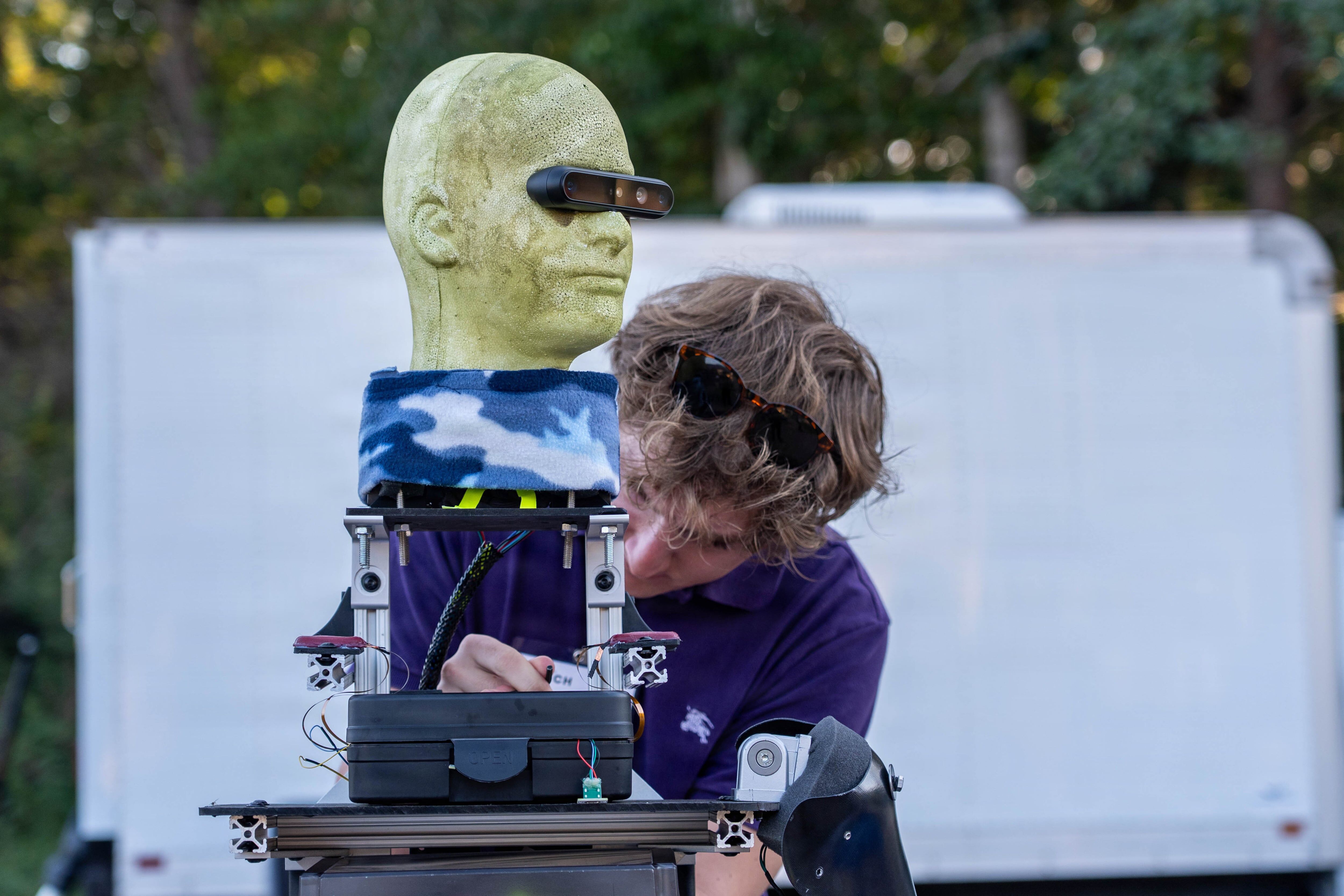
Hydroplane and ACES Group competed with their batteries, while Velocity Explorations entered software that enabled its robot to listen to radio traffic between people and understand their movements and tasks. Using that information to develop an understanding of the broader battlespace, the platform could then determine how to act.
Ras Labs tested highly sensitive fingertip tactile sensors that allowed a robot to handle delicate objects.
While multiple companies said they participated because it was a chance to test their products, Dr. Anita Sengupta, Hydroplane’s founder and chief executive, explained that her company has traditionally done work for large structures and aircraft, but recently started working on smaller and portable systems.
“We saw a good overlap between developing a power system for a humanoid, whether it’s a person or a robot, as well as the drone use case, so it just seemed like an interesting use case for us to take our technology to,” she said.
For the competition, her company adapted a 10-kilowatt system originally designed for the Marine Corps in 2024, but made it smaller because the humanoid only needed a few kilowatts. The device utilizes a fuel cell similar to what a generator uses, but instead of using diesel fuel, it uses hydrogen. Sengupta explained that the benefits are that it has about three times the energy density and a higher conversion efficiency.
Although Hydroplane didn’t directly power a humanoid robot with its fuel cell, the Army tested it to see if it could power a humanoid robot. In turn, Hydroplane helped establish those standards, with the intent to eventually collaborate with a humanoid robot team.
The future
In the recent announcement, the Army said the competition revealed a clear picture of “both the progress commercial industry has made in humanoid robotics and the technical challenges that remain.” The findings, the service said, will help it direct research toward technologies that offer the greatest return for warfighters.
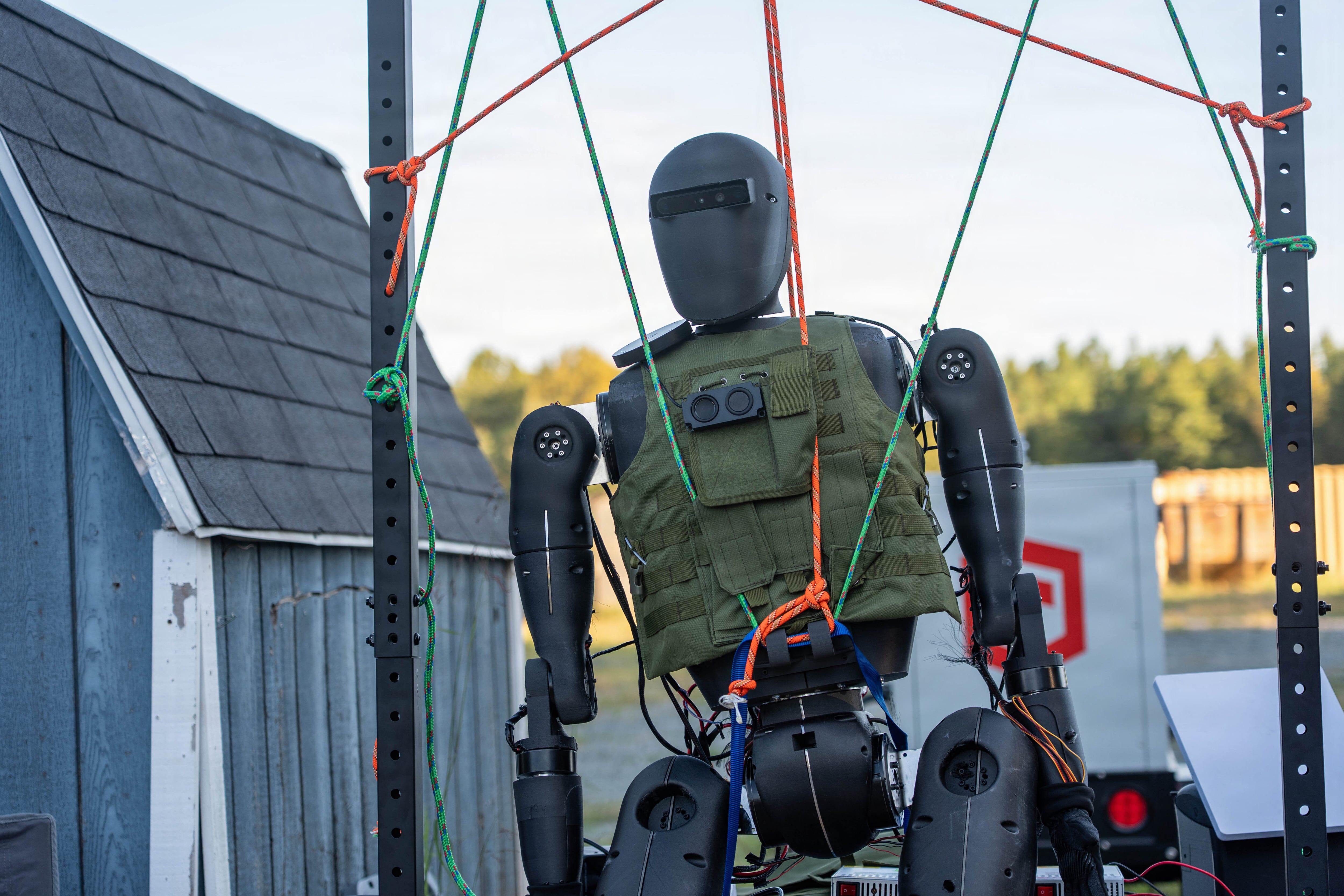
But while humanoid robots might eventually take on more complex military tasks, Griffin said the industry is still a long way from developing machines like Arnold Schwarzenegger’s T-800 from The Terminator franchise.
“I don’t think that any person who has a modicum of ethics is going to say that we need to be having these robots making life or death decisions,” he said, noting how easily current AI models can be confused or manipulated.
Instead, Griffin said the future of humanoid robotics will depend in part on what investors want the machines to do. Industrial companies, for example, may see opportunities to automate tasks typically performed by humans.
“Our goal is to be able to make robots that remove people from having to do harmful tasks,” he said about his company, pointing to scenarios such as first responders entering burning buildings and nuclear cleanup.
Daniel Terrill is a contributor to Military Times. He’s been reporting on military issues, the gun industry, and the outdoors for nearly two decades. Although writing is his passion, he’s been a Marine, police officer, and, perhaps the most dangerous job of his career, a substitute teacher.