
AUKUS partners test autonomous systems as Europe weighs maritime surveillance needs
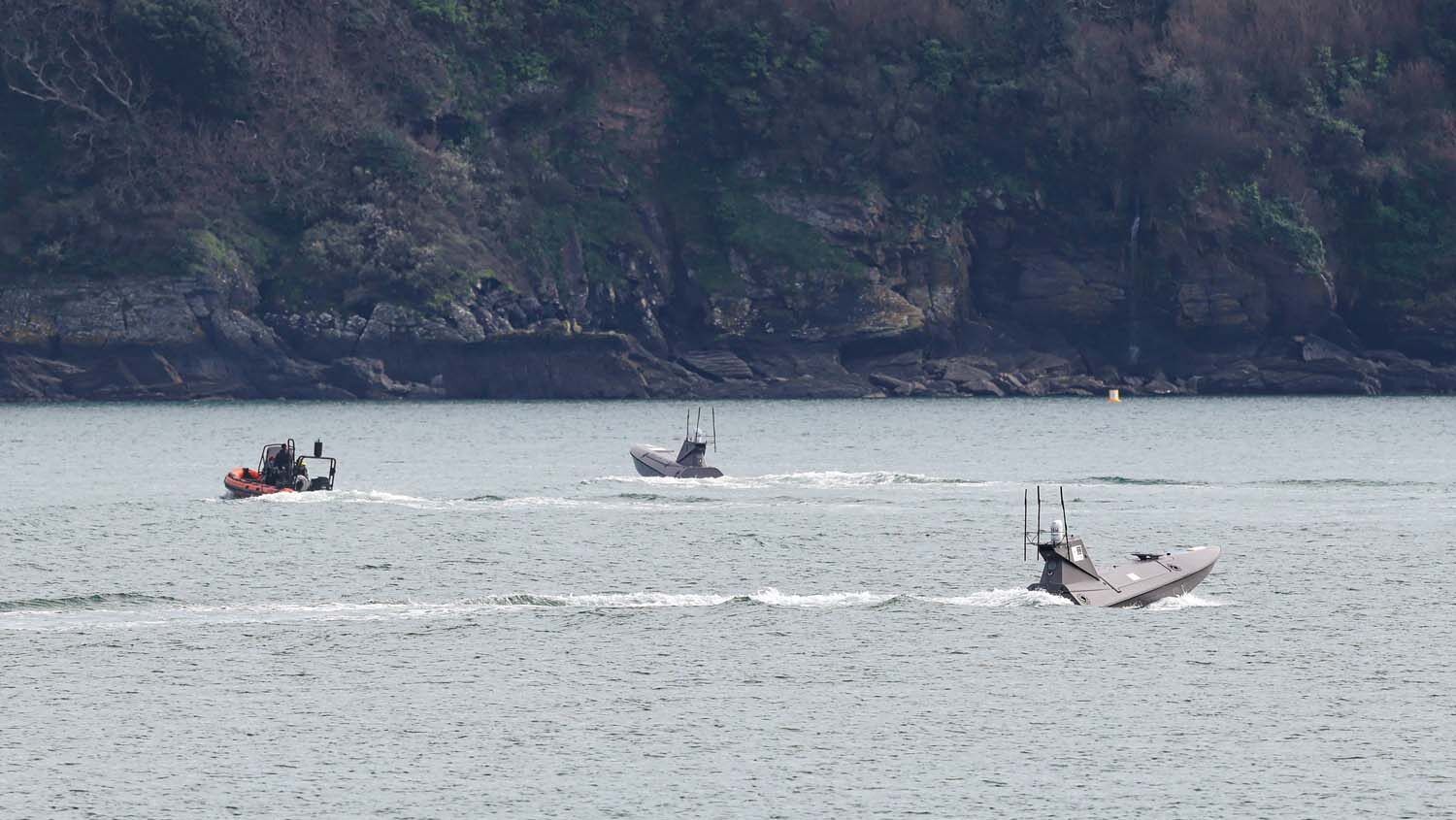
WASHINGTON — The US, United Kingdom and Australia wrapped up a naval exercise this month that the Royal Navy billed as the three countries’ “largest ever demonstration of uncrewed and autonomous technology” in support of AUKUS Pillar II.
During the Maritime Big Play exercise, the AUKUS partners tested autonomous systems off the coast of San Diego, California, and integrated them into maritime operations — including tracking underwater threats and sharing data across platforms. The exercise comes as the UK and other European countries look to expand their maritime surveillance capabilities with autonomous systems amid growing security concerns in the region.
The UK headed up the anti-submarine warfare (ASW) portion of the exercise, using “a range of uncrewed surface vessels, underwater gliders, drones and subsea vehicles” during the exercise, according to a Royal Navy news release. Specifically, the ASW component focused on using both manned and unmanned systems for tracking and surveillance missions.
Altogether, the exercise was designed to showcase more than 40 technologies from the three AUKUS countries — including manned, unmanned and “multi-domain autonomous” systems, the release said.
The Royal Navy did not respond to a request for comment regarding how many and which types of unmanned systems were used in the exercise. The US Navy said in a news release that the drill’s ultimate goal was to “achieve milestones in integrating mature robotics and autonomous systems within AUKUS coalition maritime operations.”
The three countries established the AUKUS framework in 2021, with Pillar I focused on providing Australia with Virginia-class nuclear-powered submarines by 2032. Under Pillar II of the deal, the nations are working together to jointly develop and field advanced military capabilities.
“Maritime Big Play demonstrates the real, tangible progress we are making with our AUKUS partners to deliver cutting-edge autonomous capability at sea,” Second Sea Lord Vice Adm. Paul Beattie said in a statement this month. “This is about more than technology on display, it’s about proving that our forces can operate together seamlessly, sharing data and combining assets to stay ahead of future threats.”
European nations are broadly pursuing maritime surveillance capabilities, with different priorities depending on each country’s geographic location and security concerns — from monitoring Russia’s activity in northern waters to tracking the flow of people through the Mediterranean in the south.
““As a result, countries are buying small numbers of manned patrol platforms and combining them with uncrewed aircraft,” Bryan Clark, director of the Hudson Institute’s Center for Defense Concepts and Technologies, told Breaking Defense. “In the south, they tend to want uncrewed aircraft plus manned patrol ships to intercept migrants. In the north, countries are buying manned ASW patrol aircraft like the P-8A [Poseidon] or Atlantique, plus uncrewed aircraft like the MQ-9B [SkyGuardian].”
Zak Schneider, a visiting fellow at the Casimir Pulaski Foundation in Warsaw, also noted that maritime surveillance platforms have become critical capabilities for monitoring Russia’s escalation in the European theater.
“Sensors, ISR, intel and other data feeds are vital to being able to act on/forecast in advance new attacks in the maritime domain,” Schneider told Breaking Defense. “So, surveillance is also about the proliferation of sensors, detectors and reconnaissance that can feed data into these big systems.“
As European allies look for better ways to detect and track underwater threats, the AUKUS partners are also pursuing new sensor technologies for uncrewed systems. To cap off the Maritime Big Play exercise, the UK’s Ministry of Defence announced Tuesday that the country would spearhead development of three advanced undersea sensor payloads for unmanned systems, which the ministry said would become “available” to the UK, Australia and the US in 2027, in support of the AUKUS agreement.
The sensor payloads consist of a synthetic aperture sonar, a deployable anti-submarine warfare sensor and a deployable non-kinetic effector. The systems will be designed to conduct surveillance, collect underwater information and dispatch sensors that can track and identify underwater threats, according to the Ministry of Defence.
“The UK is all in on AUKUS, and this cutting-edge technology shows why,” UK Minister for Defence Readiness and Industry Luke Pollard said Tuesday in a statement. “By leading development of these sensor payloads, we’re putting British innovation at the heart of AUKUS and strengthening our collective undersea capability.”