
With daily jamming of US forces on Korean Peninsula, industry needs resilient solutions: USFK commander
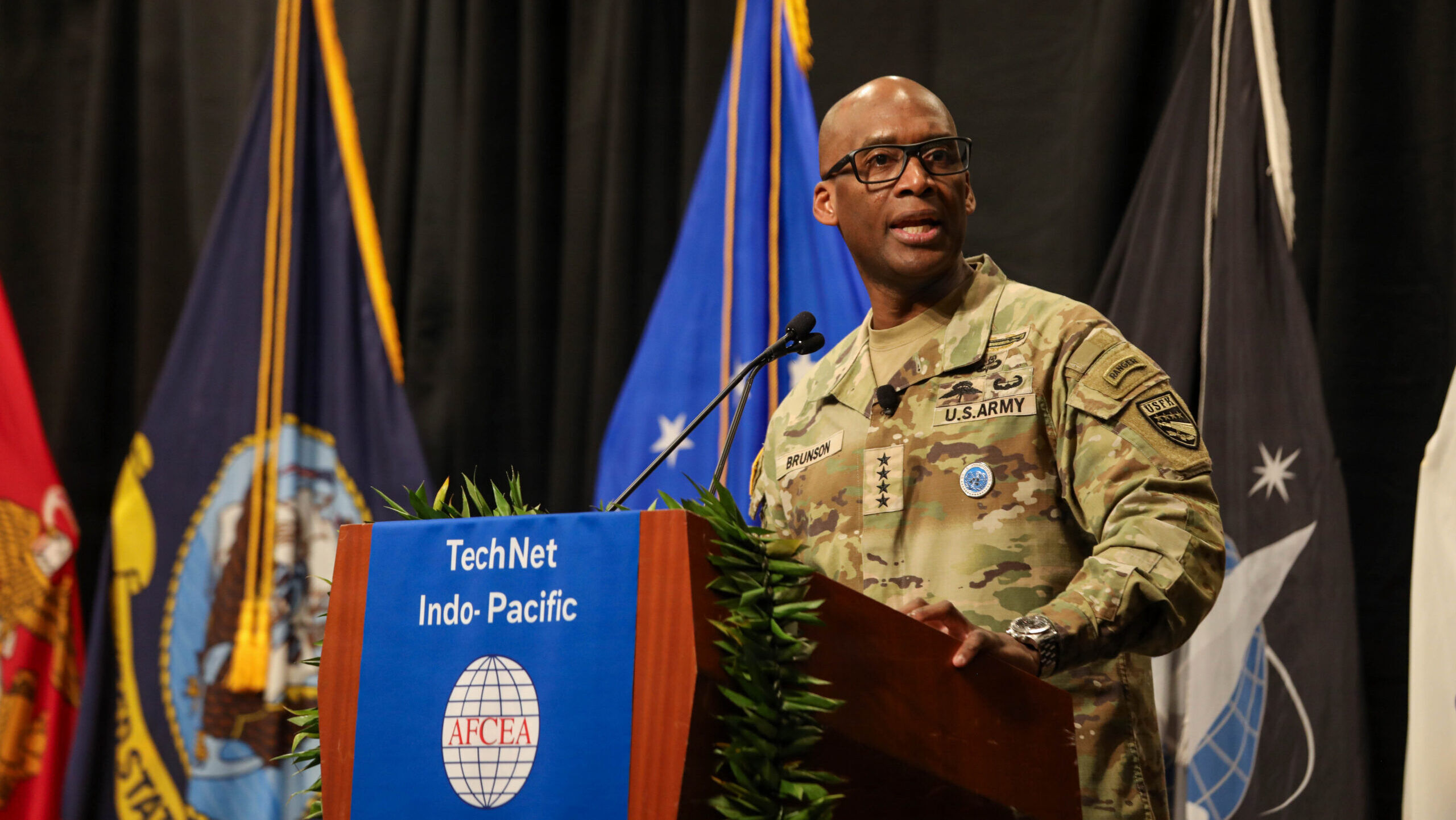
WASHINGTON — Electronic systems used by US and allied forces are jammed daily on the Korean Peninsula, making it one of the most “violently contested electromagnetic environments on the planet,” according to a top US commander.
“Our adversaries practice electronic attack daily. They jam GPS in the West Sea. They attempt to blind our servers, our sensors, and our networks,” Gen. Xavier Brunson, commander of US Forces Korea, said Tuesday during a presentation at AFCEA TechNet Indo-Pacific in Hawaii.
While Brunson did not specifically name an adversary nation, he noted earlier in his remarks that “across the demilitarized zone” US forces face a “nuclear-armed adversary that constitutionally designates the Republic of Korea as its principal enemy” — a reference to North Korea. China is also known to have advanced electronic attack capabilities in the region.
To operate in this complicated environment, Brunson said forces must have resilient and redundant capabilities.
“If your capability requires pristine satellite communications, infinite bandwidth, and uninterrupted fiber optic backbone to function, it will not survive 48 hours on the peninsula,” Brunson said to the audience consisting largely of industry members.
He noted that USFK is fielding resilient high-frequency networks alongside proliferated low-Earth orbit satellite communications and terrestrial mesh networks to maintain command and control when primary comms links are disrupted.
Brunson implored the industrial base to visit the peninsula to see the dynamic environment first hand. But, for industry members making the trip, he said they need to bring lightweight, jam-resistant waveforms with low probability of intercept and low probability of detection. He also asked industry to produce Open Application Programming Interfaces and edge sensors that can integrate with joint mission networks without vendor lock-in.
Although officials have emphasized joint and coalition interoperability for years, Brunson noted that industry must start designing systems to work with partner nations from the start.
“We can no longer design exquisite systems for pure US enclaves and then try to bolt on partner interface after the contract is signed. We must design combined from the first line of code,” he said. “To get there, we have to change a fundamental security mindset.”
For over 30 years, the mindset was to build security around hardened pipes and perimeter defenses in closed networks with stringent classification, he said. When information needed to be shared with partner nations, that approach required building a new pipe.
“In a combined fight inside the weapons engagement zone, that model has failed. Hardened pipes isolate our formations. They create operational blindness,” he said. “We must shift from network-centric perimeters to data-centric security. Tag the payload and not the pipe.”
In practice, a Korean radar detecting an inbound missile would have its track verified, ingested and pushed to coalition fires network in milliseconds, Brunson said. He stressed that information must move in milliseconds — not seconds.
Turning Industry Into ‘Pickle Millionaires’
Brunson urged the audience of industry players to pay close attention to the Pentagon’s direction and strategic documents to find what the military needs and provide it, likening industry’s North Star to pickles.
Brunson said the company Vlasic became “pickle millionaires” by recognizing that consumers needed sliced pickles — not whole ones — for their burgers.
“If you continue on a course that says, ‘Hey, man, we only do one thing, we do pickles and brine, that’s us,’ then you would never get pickles on a burger,” he said. “Pickles are long. You don’t put a pickle spear on a burger. You put those little sliced pickles on there.”
In the same vein, he urged industry to adapt its offerings to meet military requirements rather than trying to force products that don’t fit.
“The instructive part of this is, industry’s got to do the same thing. What is your sliced pickle? And if it doesn’t fit with where someone’s going, you cannot try to force it in there,” he said. “If a service tells you who they are and what they’re going to do and you choose not to try to meet the requirements of how they’re going to fight, that’s going to be a problem.”
He pointed to the Army’s recently released “How the Army Fights,” a strategic document outlining its operational guidance as an example of how companies can align their products with the service’s needs.
Brunson warned that networks will be under attack in the future as forces operate in increasingly disaggregated and distributed ways, with plans potentially changing before forces even arrive in theater. Capabilities that cannot adapt to that requirement will struggle to support the Army’s approach to warfare, he added.
“If your product can’t operate on the edge, then it’s not a product that’s going to be able to help the Army fight the way the Army is going to fight, much less the joint force,” Brunson said.