
Can inertial navigation make ground-robot swarms real?
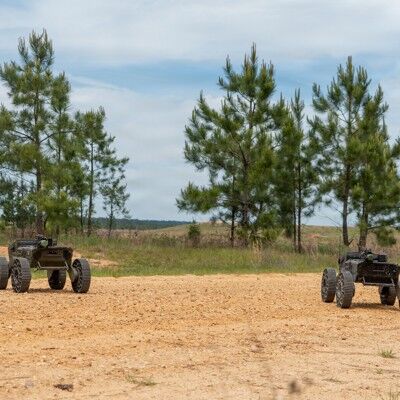
Two startups, working together for just under a week, may have found a way around the biggest obstacle to deploying swarms of ground robots: the need for GPS-free navigation in a small package.
Swarmbotics AI, which makes 100-pound autonomous robots, is teaming up with TERN, whose navigation software doesn’t need GPS, the companies announced Wednesday.
The Army has been seeking alternatives to the spoofable, jammable satellite-based system for years.
“The current environment has taught us that GPS is the first thing that gets canned on the battle space,” William Shuart, a program manager for the Army’s Pathfinder3D program, told Army magazine in January.
So the service is fielding jam-resistant GPS cards for munitions and is also working on ALTNAV, which uses a different satellite constellation. But its plans for a robot-forward ground force require a position-navigation-timing system that can get by without a satellite signal at all. The self-driving car industry, with its reliance on GPS and unstealthy LiDAR, hasn’t been much help.
Enter TERN, whose PNT system needs no signals from space, and Swarmbotics AI, an Arizona robotics company whose four-wheeled FireAnts fit roughly into a two-foot cube.
“Our teams integrated the TERN system on site here in Phoenix into the FireAnt in less than a week, which I think is really impressive. So we went from never having really spoken to these guys on a technical level at least to having the system fielded in a week,” said Drew Watson, co-founder and CTO of Swarmbotics AI.
TERN’s Independently Derived Positioning System, or IDPS, combines input from the vehicle’s own sensors, including “wheel speed, steering angle, and 3D motion data,” with onboard map data.
“We’re using the motion of that vehicle all the way down to something as as compact as a FireAnt, and through that successive motion, we’re able to output latitude and longitude at the same rate that GPS could, or twice a second,” said Shaun Moore, co-founder and CEO of TERN.
Next up: sharing that information, which Watson described as “a building block to something else.” The team wants to move toward coordinated swarm maneuvering, with teams of robots sharing data with one another in a mesh network. If each member of the swarm understands where it is and where its teammates are, that data can add value to other sensor data, such as camera or radar feeds about threats.
“The way that’s working is that each one of these FireAnts is giving a line of bearing to an enemy tank, for instance. Those are triangulated into a position of that enemy tank via multiple firings. The quality of that identification, the position of that enemy tank, is based on the position of the firings…It improves the automatic target recognition,” said Watson.
Both companies have already drawn Army attention. TERN received a $11.26 million contract in September, and both have participated in the service’s Operation Jailbreak tech demonstrations.