
From tanks to space, Norway and Germany forge ahead with ‘Hansa’ defense pact
VIENNA — German tank maker KNDS and Norway’s Ritek have begun producing Leopard 2A8 tanks in Norway, adding a land-based industrial foothold to a security partnership spanning submarines, missiles and military operations in Europe’s north.
Production started Oct. 15 in Levanger, where the companies will build 37 of the Norwegian Army’s 54 new tanks, KNDS said in an email. The facility took 18 months to establish and has a stated capacity of up to 36 tanks annually.
The production launch follows the partners’ inauguration of the manufacturing and testing infrastructure in late April. October’s milestone caps an existing procurement arrangement rather than marking a new tank purchase.
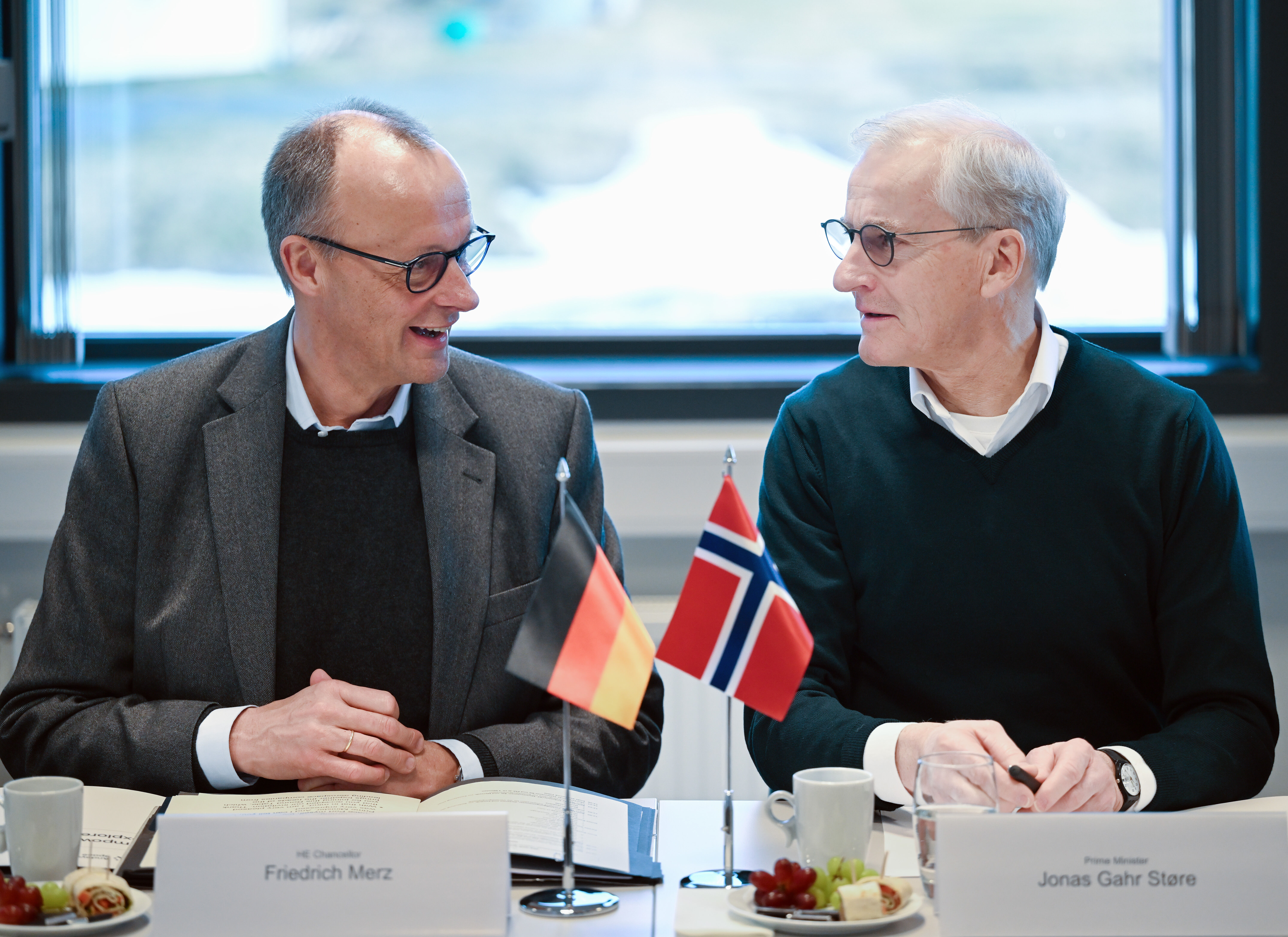
The industrial tie-up forms part of a broader mutual embrace that the two governments formalized in February through the sweeping Hansa Arrangement. Its priorities include maritime operations, combined-arms land warfare, rapid reinforcement, defense industry, and space-based surveillance, targeting and communications, according to a readout by Norway’s Defense Ministry.
An ongoing submarine partnership offers the clearest example of how equipment purchases can bind the countries’ armed forces and security strategies together. Both plan to operate six identical Type 212CD submarines, supported by cooperation on personnel training and new maintenance facilities at Haakonsvern, near Bergen, the Norwegian ministry said. Berlin and Oslo are also collaborating on the next-generation 3SM maritime strike missile.
Although industry cooperation forms the bedrock, the relationship is moving beyond mere procurement questions. Germany contributed approximately 1,800 troops to Norway’s Cold Response exercise in March, according to the German government. Norway said in February that discussions were underway about German equipment pre-positioning on its territory.
Russia’s full-scale invasion of Ukraine in early 2022 accelerated a longstanding partnership, researchers at the Norwegian Institute of International Affairs concluded in a December 2024 assessment. Germany’s growing dependence on Norwegian gas also strengthened its interest in protecting offshore infrastructure, researcher Øyvind Svendsen explained.
Germany’s military is undergoing a distinct shift toward a bigger role in the North Atlantic. Its new P-8A Poseidon aircraft, for example, are covering the so-called GIUK gap between Greenland, Iceland and the UK, a crucial area that Russian nuclear submarines must pass through to reach the open Atlantic. German Defense Minister Boris Pistorius said the aircraft would operate from Norwegian and Icelandic air bases for this mission, Defense News previously reported.
Space cooperation offers another avenue for growing collaboration. During a March visit to Andøya, Pistorius identified a joint imaging-reconnaissance satellite constellation as a project he wanted to pursue, according to his ministry.
In April, Oslo and Berlin agreed to create a bilateral space working group, with priorities including launch capabilities, space-based surveillance and secure communications. Norway is home to a valuable spaceport on the island of Andøya, which is particularly well situated for launching satellites into polar orbits, which are preferable for spy satellites.
The two North Sea countries are also cooperating in a number of other formats, including under the Multinational Multi Role Tanker Transport Fleet, which pools access to Airbus A330 MRTT aircraft for aerial refueling, strategic transport and medical evacuation, and EU HYDEF, where Germany and Norway are among five co-funders working on phase one of a European hypersonic interceptor missile.