
The fiscal risks of bringing US troops out of Europe
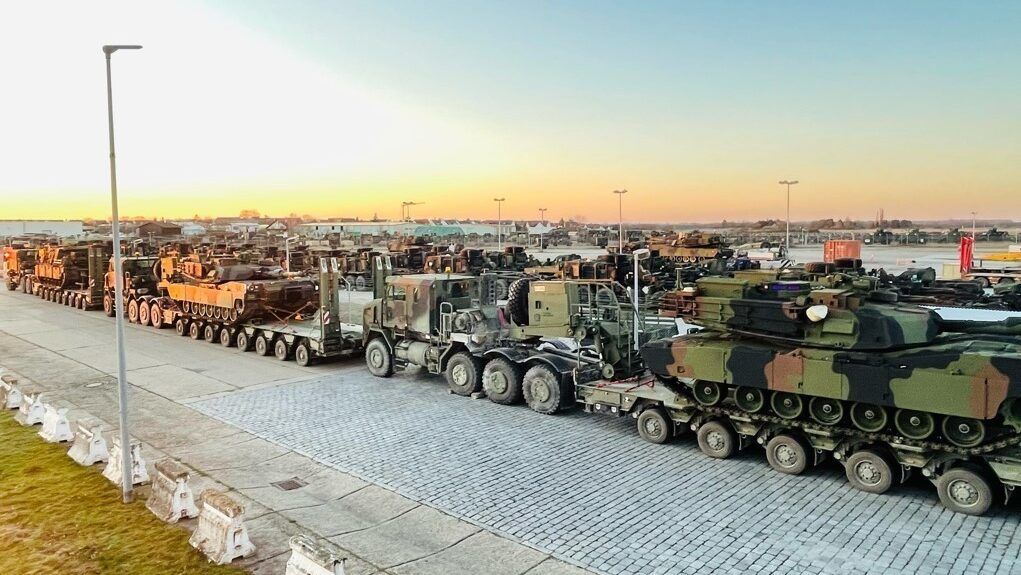
The Pentagon is in the final weeks of a 6-month review of the US military footprint overseas, and is reportedly considering major cuts to American forces based in Europe. Cutting the number of US troops based in Europe could be risky for several reasons — it could undermine the extended US nuclear deterrent, send the wrong signal to Moscow and ultimately weaken the stability and security of a region vital to US prosperity.
But there is also a serious fiscal concern that would come with such realignment. Finding space to house tens of thousands of redeployed US troops and their families somewhere across the 50 states won’t be easy, quick or cheap. Meanwhile, future US power projection would become more expensive as military facilities are vacated and returned to our European allies.
In short, even if one overlooks the strategic risks of backing away from Europe while Russia appears more aggressive than ever, the fiscal costs could be too large to ignore.
The unfolding posture review undertaken by the Department of Defense is expected to wrap up in early November. Reportedly, dramatic cuts to the number of US troops based in and/or rotated to Europe are under consideration. In comparison to the height of the Cold War — when the United States maintained nearly half a million troops in Europe — today there are about 80,000 US troops there. Roughly 65,000 of these are in Europe on typical 3-year assignments with dependents, while about 15,000 are in Europe on shorter heel-to-toe rotational deployments without dependents.
Rotationally-deployed troops are typically sent to Europe for nine months, after which they are replaced by another unit of similar size and capability for the next nine months. These persistent rotational deployments started as a response to Russia’s first invasion of Ukraine in 2014, and have been used primarily to augment the forward-stationed troops in Europe, ensuring a routine American presence across NATO’s eastern allies, which are those most exposed to Russia’s aggression.
The Department of Defense has already trimmed the number of US troops on the ground in Europe, announcing late last year the elimination of a rotationally-deployed infantry brigade (about 4,000 troops) to Romania and southeastern Europe. That deployment was relatively easy to turn off, given the process the Pentagon has used to renew it periodically and the fact that those forces were not accompanied by dependents.
Earlier this year, the Defense Department attempted to cancel another deployment, this one a rotationally-deployed armored brigade typically sent to Poland and northeastern Europe. After Poland’s president weighed in with President Donald Trump, the decision was reversed.
Shortly thereafter, news broke that there were plans inside the department to implement even deeper cuts to US presence in Europe, without conducting any kind of a study or review along the lines of what Congress requires of the administration if it seeks to reduce US troops levels below 76,000. In the wake of the Poland misstep, the more formal process that is now nearing its end was announced, apparently with an eye on fulfilling at least one of the Congressional requirements.
Another is coordination with allies, and in August the administration sent a questionnaire to other members of NATO on their support for US basing and American foreign policy more broadly. When considered alongside the recent call by the Pentagon for state leaders to bid on hosting a new military base – necessary if thousands of US troops and dependents relocate from Europe to America – it seems clear that deep cuts are not merely possible, but rather likely.
Cost Imposition
There are a number of ways that removing forces out of Europe could hit taxpayers in their wallets.
First, there are geopolitical realities. A significant downsizing of US forces in Europe at a time when Russia’s war in Ukraine rages and its hybrid attacks against the West ramp up is likely to only incentivize Moscow in its efforts to undermine security and stability in Europe. If Moscow succeeds, a destabilized, insecure Europe – still America’s most important trade and investment partner – will inevitably impact the livelihoods of average Americans.
However, there are other, more immediate costs to consider. Based on historic data of what the Pentagon paid between 2005 and 2011 to expand Fort Bliss so that it could accommodate an additional 25,000 troops, building additional facilities to host 15-25,000 US troops, plus their dependents, is likely to cost at least $8 billion, in inflation-adjusted terms.
Additionally, if US troops depart Europe, Washington will likely give up the European facilities that hosted them, which means losing access to bases that enable cheaper power projection.
Take for example the attacks on Iran in recent months. Roundtrip bombing missions from the United States to Iran take about 36 hours, while bombing missions from the United Kingdom take as little as 15 hours roundtrip. Given the cost of operating B-1 and B-52 bombers ($97,600/hour and $66,700/hour, respectively), flying from the UK saved the US taxpayer $2.05 million for each B-1 sortie and $1.4 million for each B-52 sortie. By early April, the United States had conducted 62 bombing missions against Iran, only 18 of which had left from North America. If we assume the remainder flew from Europe, which seems likely, the American taxpayer saved about $75 million in just the first five weeks of the war against Iran by having access to bases in Europe.
Reducing US force posture in Europe – for example, to shift some assets to the Pacific – may make sense. But doing so now carries significant strategic risk vis-à-vis Russia and the security of a continent that remains vital to American prosperity. Moreover, it also likely means higher fiscal cost at a time when US debt already seems insurmountable.
John R. Deni is a research professor at the US Army War College, a nonresident senior fellow at the Atlantic Council and a nonresident senior fellow at the NATO Defense College. The views expressed are his own.