
Airbus ends Wingman drone to meet Germany’s accelerated operations timeline
MUNICH — Airbus has scrapped the development of a futuristic, unmanned wingman concept aircraft as a result of Germany accelerating the timeline for the aircraft to potentially enter service.
The European manufacturer is moving away from its Wingman drone platform, first unveiled at the Berlin Air Show in 2024, to instead focus on developing the U760 Ravenstorm Collaborative Combat Aircraft (CCA), according to Laurent Le Quément, head of future air power and UAS marketing at Airbus.
“Customers have asked us to bring the need [service entry] forward,” he told reporters here at the International Fighter Conference. “We decided to recheck our whole approach and to go for this [the U760].”
The original timeframe for fielding the Wingman was “definitely not early 2030s,” added Le Quément. At the CCA’s unveiling in 2024, Michael Schoellhorn, CEO of Airbus Defence and Space indicated that the timeline was much closer to 2040.
Despite Le Quément not identifying the customer by name, Airbus stated in 2024 that the Wingman aircraft was designed specifically to meet emerging operational requirements of the German Air Force.
In light of the tighter timeline, Airbus decided to pursue development of the U760 because it is an evolution of the company’s Barracuda drone demonstrator’s “trusted design,” said Le Quément. Work on Barracuda began in 2003, initially as a secret project and subsequently led to the completion of six flight test campaigns.
One significant difference distinguishing the Wingman and the U760 is that the Wingman was to be fitted with a bespoke engine created by Rolls Royce Deutschland and Spanish engine manufacturer ITP Aero. Meanwhile, the U760 will be fitted with a business jet engine, Le Quément explained.
“If you have something which is [intended to be] affordable, you need to be at a certain ratio of a fighter,” said Le Quément. “But if you’re talking then about something … which would be bespoke for air-to-air with an AESA [Active Electronically Scanned Array] radar in there, then you would be at a much higher cost.”
Airbus was targeting an estimated cost for the Wingman equivalent to “one third” of a manned fighter platform, per past Schoellhorn comments.
Ravenstorm offers a high subsonic cruise speed and features a 500kg (1102.3 lbs.) internal weapons bay capacity, per Airbus literature. It is the second in a family of three CCA designs also including the U740 Valkyrie, and an unnamed third system.
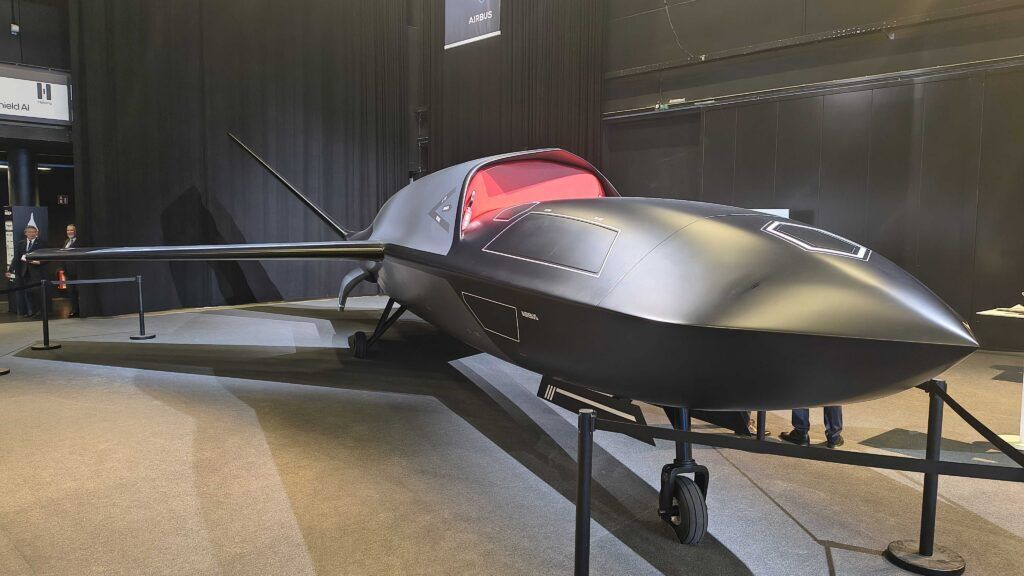
The U740 Valkyrie is being developed to support a 2029 German requirement, followed by Ravenstorm’s push to enter service in 2032; and rounded off by a future design that remains under assessment.
“The third one you will not see it” today, said Le Quément, noting that the aircraft is at a study phase at present, “but the idea is to investigate more bespoke designs, which will be done either for air-to-air or for EW [Electronic Warfare], and that might be something which would tend to be more exquisite.”
The company further provided an update on the U740 program, which involves an industry partnership with US firm Kratos.
Building off a first flight out of Northern Europe last month, the aircraft is scheduled to take part in a crewed-uncrewed teaming flight in collaboration with a Eurofighter Typhoon fourth-generation fighter jet next year, Marco Mehling, chief engineer system of systems concepts and capabilities at Airbus, told media in Munich today.
It was recently reported that Germany’s 2029 CCA requirement timeline is in doubt, after rethinking a direct procurement of Boeing MQ-28 Ghost Bat drones. The move means that competitors like Airbus, offering the Valkyrie, are still in the running to secure an order from Berlin.
“[If the] capability is used or pushed back, and they [Germany] need it in [20]32, of course, this is good for us, but we want still to be ready by the timescales that were initially mentioned”, said Mehling.