
MBDA high-speed strike missile to have range ‘far’ exceeding Exocet
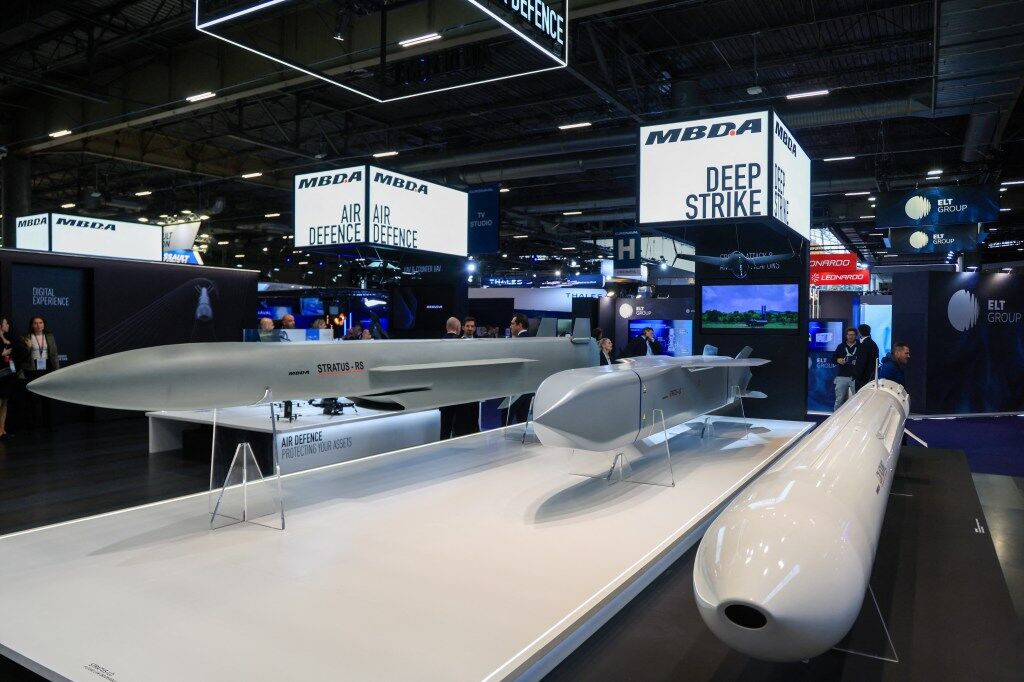
PARIS — MBDA targets a range for its future high-speed strike missile Status RS that will be “far, far, far” beyond that of the Exocet anti-ship missile with its more than 200-kilometer range, said Olivier Gauffin, the company’s deputy director for sales and business development, at a briefing at the Euronaval maritime-defense exhibition on Tuesday.
The high-supersonic missile will cover four missions, including deep strike and anti-ship strike, suppression and destruction of enemy air defenses, as well as strikes against large aircraft including airborne warning systems and tankers, Gauffin said on Tuesday.
Stratus RS, for rapid strike, is being developed for France and the United Kingdom, and MBDA is awaiting a development contract from France’s Directorate General for Armament on behalf of the two partners.
The company is simultaneously working on a stealthy subsonic cruise missile with a larger warhead called Stratus LO, for low observable, on behalf of France, the U.K. and Italy.
“The goal is very clear, it’s to face the threat of the decades to come, and we have two options to do it, which are complementary,” Gauffin said. “One is more a Ferrari, and the other is more a truck, a stealth truck.”
The high-speed missile will be able to combine very low or very high trajectories to defeat hard-to-destroy targets such as frigates and destroyers or ground-based air defense systems, according to Gauffin. The missile will have a liquid ramjet engine that can be throttled, and will be highly maneuverable, the MBDA executive said.
Stratus RF will have a radio-frequency seeker combined with synthetic aperture radar, which provides the missile with a land-attack and a top-attack capability, according to Gauffin, who said Thales is providing the seeker technology. The idea for the slower, stealthy missile is to have only passive radio-frequency and infrared sensors, and no radar.
While the equipment in the Stratus RF missile will be new, it’s based on technology MBDA uses in other missiles, the executive said. The company has already done “a lot of trials” around the critical components, including propulsion, seeker, warhead and data management, and full development of the missile is expected to start “very soon,” Gauffin said.
MBDA uses ramjet technology in its Meteor air-to-air missile.
Both Stratus missiles will be able to be air-launched from platforms including the Rafale, the Eurofighter Typhon as well as the future aircraft being developed in the Global Combat Air Platform, with a size and mass “very close” to the Storm Shadow cruise missile. The missile will use a booster for launch from ships or land.
MBDA expects flight testing of both Stratus missiles to start before the end of the decade, with the missiles to enter in service at the beginning of the 2030s.
The size of the Stratus RF is not compatible with NATO-standard size torpedo tubes, meaning the missile is not envisaged as being submarine launched, according to Gauffin. For vertical launch, the missile would require a new, wider version of Naval Group’s Sylver vertical launch system, though Gauffin said there would be no change to the shipborne space occupied by the VLS.
The company also presented details on a new version of its Naval Cruise Missile, with production to start in early 2030. The updated version will be more resistant to satellite-navigation jamming, with increased survivability and new sensors, and keep the same size but with increased range and lethality, said Sophie Bourdais, vice-president for strike at MBDA.
The updated missile will also benefit from new mission-preparation software called Fastrike that cuts target planning down to minutes from hours, according to Bourdais. MBDA plans to integrate the capability in the SCALP EG/Storm Shadow cruise missile and the existing Naval Cruise Missile before 2030, the executive said.
The Naval Cruise Missile was presented as part of the European Long-range Strike Approach, and there is interest from a number of countries in the land-based variant MBDA has developed, according to the company.
MBDA is still waiting for a development contract from the DGA. The production line for the Naval Cruise Missile in France is inactive but remains in place, and can be restarted to produce the updated version, according to Bourdais.