
F-35C completes first launch and recovery trials on a Ford-class carrier
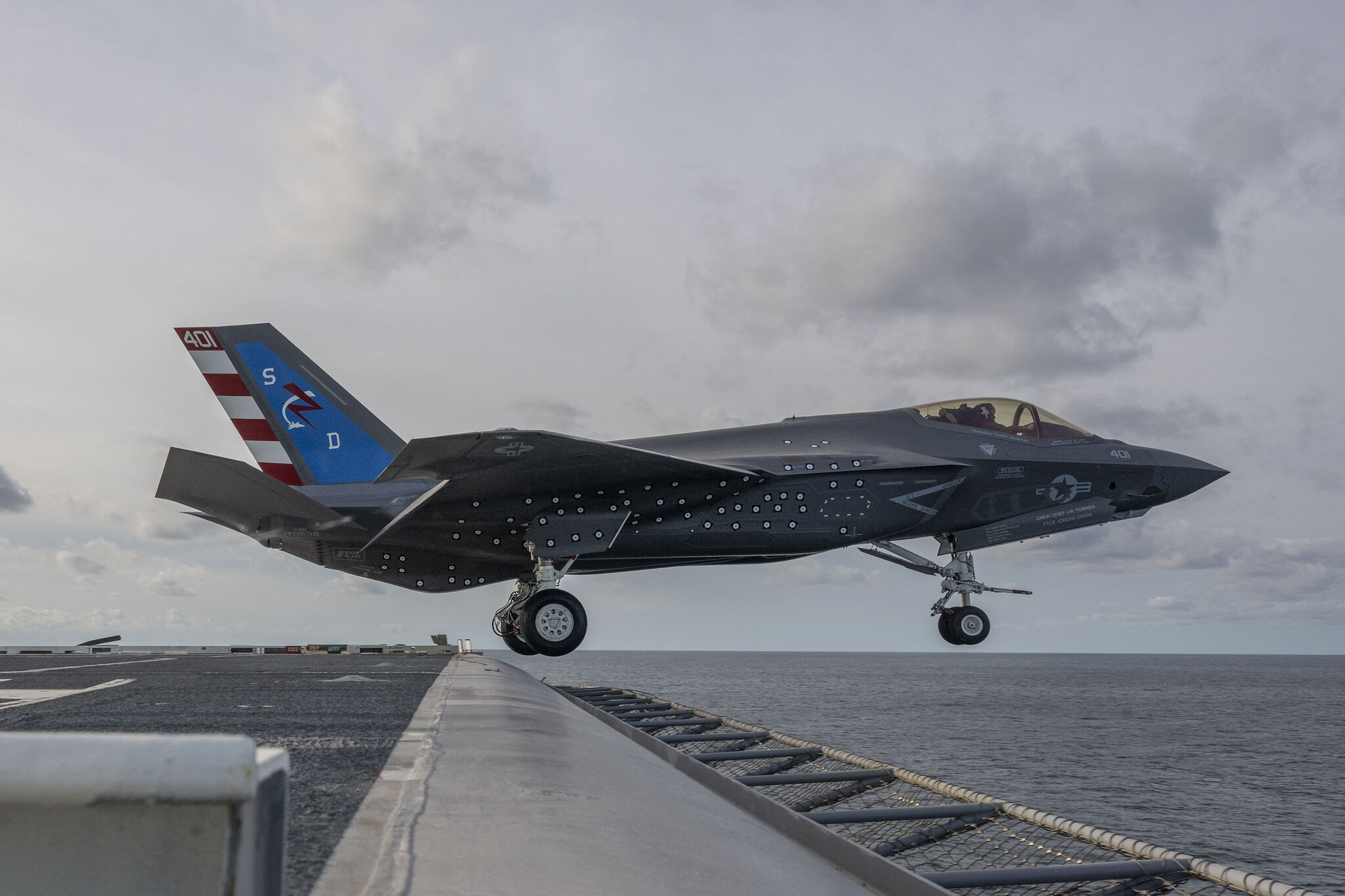
Two Navy F-35C Lightning II fighters have completed the jet’s first round of launch and recovery testing aboard the future USS John F. Kennedy, the Navy’s second Gerald R. Ford-class aircraft carrier, Lockheed Martin said Thursday.
Over 11 days of testing that began Oct. 13, the Navy’s 251st birthday, the two jets made 34 flights and logged 122 catapult launches and 122 arrested landings, the company said. The aircraft belong to Air Test and Evaluation Squadron 23, or VX-23, known as the “Salty Dogs,” at Naval Air Station Patuxent River, Maryland.
The flights were part of Kennedy’s Aircraft Compatibility Testing, which assesses how the ship’s launch and recovery equipment works with Navy aircraft, according to the Navy. The first arrested landing came on Oct. 13, and the first catapult launch on Oct. 14, Navy photo captions show.
Unlike Nimitz-class carriers, which launch and recover aircraft with steam catapults and hydraulic arresting gear, Ford-class carriers use the Electromagnetic Aircraft Launch System, or EMALS, and the Advanced Arresting Gear, or AAG. Lockheed said EMALS allows smoother, more precisely controlled launches, while AAG can handle a broader range of recovery conditions.
The Ford class also has a smaller island, the tower that houses the bridge and flight control, set about 140 feet farther back than on Nimitz-class ships. Lockheed said the island and a redesigned flight deck change airflow, exhaust patterns and deck operations.
The at-sea testing followed shore-based trials conducted from January 2024 to May 2025, the company said. It validated the jet’s structural models and verified the software and equipment behind EMALS and AAG. The data will help develop the launch and recovery guidance crews use on Ford-class ships.
“This is a critical event for the F-35C, Kennedy, and the United States Navy,” said Sean Jackson, vice president of Lockheed Martin’s F-35 Development Program. “For the first time, the aircraft has demonstrated launch and recovery operations from a Gerald R. Ford-Class flight deck, advancing the integration of fifth-generation fighter capability with the world’s most advanced carrier technology.”
Jackson also said that upon completion of this test phase, “the Navy has now cleared the F-35C for operations across its entire fleet of aircraft carriers.”
Defense News has asked Lockheed for details about the clearance and is awaiting a response.
“The ships are cleared to launch and recover F-35s once the launch and recovery bulletins are published,” a Lockheed official told Defense News. “They will not be ready to deploy until fully outfitted with supporting equipment.”
The Navy, the official added, has the “final clearance.”
The F-35C first landed on a carrier in November 2014, aboard USS Nimitz off San Diego, and has since deployed from modified Nimitz-class carriers. The lead ship of the Ford class, USS Gerald R. Ford, has not deployed with the jet.
In 2019, a Navy spokesman told USNI News that both carrier classes could operate with F-35Cs by design but needed changes, such as more robust jet blast deflectors and classified spaces, for the jet to be more effective on a full-length deployment. Stars and Stripes reported in October that the Navy plans to retrofit the Ford to operate the F-35C.
Kennedy received those modifications during construction. In 2020, the Navy changed the ship’s construction contract to meet a legislative requirement that Kennedy be capable of deploying with the F-35C.
The Navy took preliminary acceptance of Kennedy on Sept. 29, after the ship completed acceptance trials in August. Preliminary acceptance allows the crew to test and train at sea while the shipbuilder finishes its work. The Navy said at the time that the ship was about 99% complete, and formal delivery is planned for spring 2027.