
Umbra unveils new family of SAR satellites
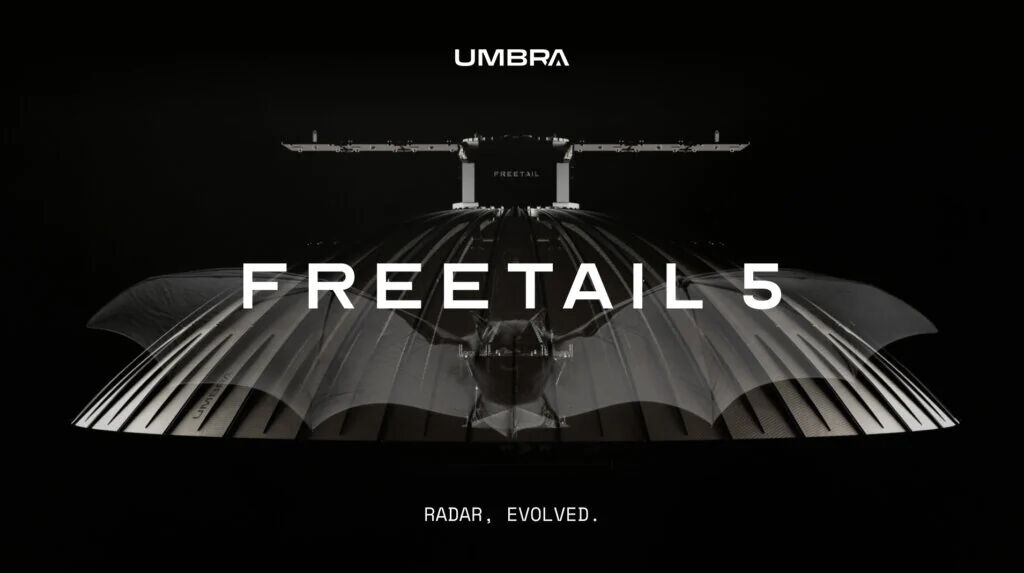
WASHINGTON — Space technology company Umbra unveiled a new line of synthetic aperture radar satellites that the company says will bring improved accuracy and an expanded capability set.
In a Nov. 23 press release, Umbra said it plans to start launching Freetail, its new family of U.S.-built spacecraft, in early 2028. The first model, Freetail 5, will feature increased radar transmit power and improved microwave efficiency, the company said.
“We’re building Freetail 5 to deliver the performance, resilience and mission flexibility of much larger systems in a highly agile platform,” Umbra CEO David Langan said. “With four times the radar power, twice the antenna area and hourly global revisit, Freetail 5 is designed to collect more across greater areas to deliver unprecedented operational value.”
The company is pitching the platform for both U.S. and international customers. The system is highly customizable, Umbra said, and can provide “hundreds of high-quality images per satellite per day” with resolution as high as 5cm.
The system builds on Umbra’s existing constellation of all-weather SAR satellites operating in low Earth orbit. The radar sensors installed on those spacecraft allow them to capture high-resolution imagery of Earth, day and night and through cloud cover. That capability is key for a range of users, from defense and intelligence operators to disaster response and the maritime industry.
“The spacecraft will operate in both polar and mid-inclination orbits, allowing for global access with more frequent collection over priority regions,” Umbra said. “FT-05 can be configured to support a broad range of mission requirements and applications.”
The firm is building Freetail 5 at its 50,000-square-foot manufacturing facility in Goleta, Calif. The satellite will use Umbra’s own flight software and 90% of its components are built in house, making it the firm’s most vertically integrated product to date.
“Refined over 14 missions, the FT-05 bus architecture utilizes flight-proven selective redundancy across critical subsystems,” Umbra said. “Its mass and volume allow the spacecraft to be compatible with dedicated launch and rideshare configurations across U.S. and international launch providers. The spacecraft accommodates hosted payloads, including sensors, communications equipment and processors.”
Umbra didn’t disclose how many Freetail satellites it intends to build, but said it plans to launch “a larger constellation” after the first mission.
The company, founded in 2015, has long sold its Earth observation data to military and commercial customers. Last year, it launched a new space systems business unit focused on building and selling satellite hardware like solar arrays, attitude and maneuvering systems and radio communications links.
Todd Master, chief strategy officer at Umbra, told SpaceNews at the time that the company’s goal is to help ease supply strains within the satellite industry, offering buyers another option for key components, and to meet demand for U.S.-made components.