
First Dark Eagle hypersonic battery ‘fully fielded,’ Lozano says
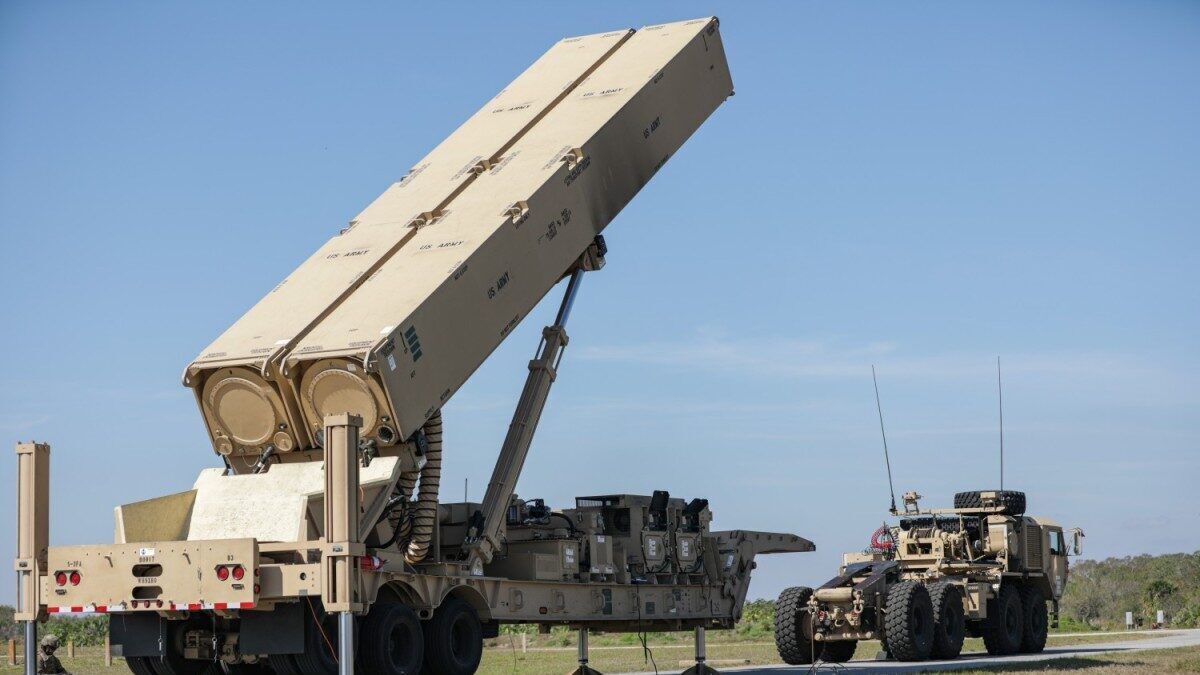
WASHINGTON — The Army has officially fielded its first Long Range Hypersonic Weapon battery, according to the service’s top general in charge of munitions.
“It is fully fielded. It is ready to go,” Lt. Gen. Frank Lozano, Program Acquisition Executive (PAE) for Fires, told Breaking Defense on Nov. 19 during an interview. “It is a global deployable and employable warfighting capability. Those soldiers and those units have everything that they need to employ, fight and win.”
Lozano declined to disclose when or where the first battery was fielded, offering few details about the milestone beyond confirming that the weapon is operational and ready for deployment.
The news comes after years of challenges with developing and fielding the LHRW, also known as the Dark Eagle. The Army initially planned to field the first battery in 2023, but testing woes — including a mechanical engineering problem with the launcher — prevented the service from meeting that goal. The Army later pushed its fielding target to September 2025, but missed that deadline as well.
According to a recent report from Bloomberg, the Army had still not completely fielded its first LRHW battery as of October 2026 — putting the service nearly three years behind schedule. The Army’s program office reportedly said in a statement to Bloomberg at the time that it “continues fielding activities” for the Dark Eagle and must undergo more training and other sustainment and readiness work “before declaring the system fully fielded.”
When asked if the report from October were inaccurate, Lozano said he didn’t “want to go so far as to say that.” Instead, he said “this is a rapidly evolving space, and things can happen very quickly, and for all the right reasons, we in the Army and we at PAE [Program Acquisition Executive] Fires are being very, very aggressive about producing, developing and fielding new capabilities that include Dark Eagle.”
Asked when the first battery officially reached full fielding status, Lozano pointed to the fact that some of the weapon’s ground support equipment had been delivered as early as 2021, making it difficult to identify a specific date for the milestone.
Hypersonic Capabilities
Hypersonic missiles can fly at speeds of Mach 5 or greater and are designed to maneuver unpredictably through the Earth’s atmosphere. Over the past several years, both the Pentagon and Congress have shown a growing interest in developing and acquiring such systems, especially as reports have circulated stating that Russia and China have a number of hypersonic weapons programs in their arsenals.
The Army’s Dark Eagle program was developed alongside the Navy’s Conventional Prompt Strike project. The weapons have the same glide body system, but the Army will integrate it onto ground launchers and the Navy will launch it from Zumwalt-class destroyers and Virginia-class submarines once fielded.
One Dark Eagle consists of four trailer-mounted transporter erector launchers, each carrying two all-up rounds plus canisters, long with a battery operations center and support vehicle.
The Army and Navy chose to pause production while addressing problems identified during testing, according to a Government Accountability Office report from July. Further, the GAO report found that “the contractor [Lockheed Martin] has continued to experience issues at its facility.” This has resulted in “missing, inconsistent, and unclear work standards for missile production.”
Lozano declined to provide further details about manufacturing issues, but said preventing similar problems in the future would require more rigorous qualification testing of individual missile components.
That includes “making sure we test all the solid rocket motors, so that we have a high level of confidence that those things work and perform as required, making sure we’re testing and checking out the integrated guidance sections, making sure we’re testing out and qualifying the inertial [navigation] units [and] making sure we’re testing seeker and seeker components,” he said.
Though Lozano declined to comment on where the battery was fielded, Breaking Defense previously reported that soldiers within the 1st Multi-Domain Task Force long-range fires battalion, 5th Battalion, 3rd Field Artillery Regiment at Joint Base Lewis-McChord in Washington received system components and training in anticipation of becoming that first operational unit with the new weapon in 2023.
The Army is now working to field the second and third batteries, though Lozano could not speculate when they would be ready due to operational security concerns. The service is “already over halfway through production” of the third battery, he noted.
“I don’t have a firm date on the wall, I think we’ll see that the second battery and the third battery will realize their full capability at a faster pace and a faster rate than the first battery did,” he said.
New Companies Incoming?
Separately, Lozano indicated the Army could eventually open the LRHW program to additional vendors, potentially introducing more competition that could offer better performing capabilities at a lower cost.
“I’d like to have two or three vendors all in production against a singular requirement, because then that gives me a lot of production flexibility and options,” he said. “Should any one vendor have any kind of quality or production or manufacturing challenge in delivering, it gives me options to kind of maybe buy more or less from one of the vendors over another.”
Lozano said the Army is also pursuing hypersonic weapons that would fill the capability gap between Dark Eagle and shorter-range systems like Castelion’s Blackbeard hypersonic missile through the “scaled hypersonics program.”
The Dark Eagle uses a land-based truck system to fire rounds capable of traveling over 3,800 miles per hour towards targets within a 1,725-mile range. The Blackbeard has a shorter range, smaller form factor and is cheaper. Therefore, platforms discovered through the scaled hypersonics program would ideally have a range between the Blackbeard and Dark Eagle.
“All of our long-range fires efforts and capabilities are significantly important to the Army and to the Department of [Defense], and so they all remain a very high priority for us,” Lozano said.