
Is the Finnish-Norwegian call with Putin a crack in Nordic resolve, or the start of a new path?
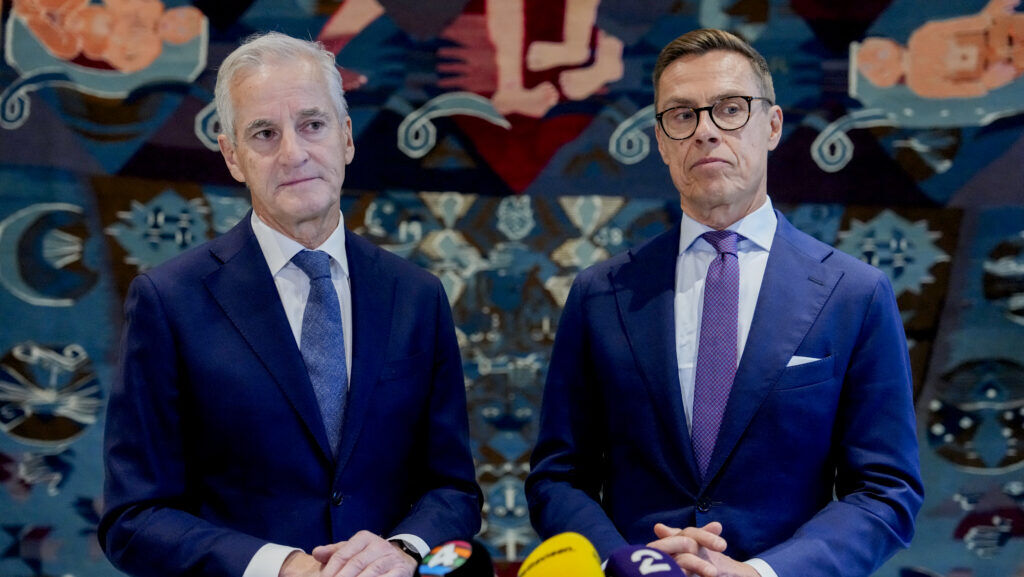
STOCKHOLM and MILAN – A small fissure appears to have opened in the Nordic nations’ stance towards Russia, as the leaders of Norway and Finland held a rare call Tuesday with Russian president Vladimir Putin to discuss Ukraine.
While Finnish President Alexander Stubb and Norwegian Prime Minister Jonas Gahr Støre said the call was done with the blessing of Ukraine, it led to quick pushback from Denmark and caution from Sweden, underlining a key issue as Europe is in its fifth year of the Ukraine conflict — keeping nations aligned on how to handle Moscow.
“It was a 90-minute call. It was substantial and went into the issues. It was professional. There are large gaps in positions,” Norway’s Prime Minister Støre told the public broadcaster NRK after the conversation with Putin, adding that the call had been planned to be only 20 minutes in length.
“We stand by Ukraine and defend Ukraine’s right to defend itself. And we emphasize that there must be a diplomatic path to end this war in a lasting and just manner,” Støre said.
The joint phone call to Moscow was a follow-up to a meeting in Oslo one week earlier, where Stubb and Støre hosted Ukrainian President Volodymyr Zelenskyy and US special envoy Steve Witkoff. Representatives from several other countries, including Germany and Poland, were present at that meeting.
Western European leaders have largely avoided speaking with Putin since Russia’s full-scale invasion of Ukraine in February 2022. The last notable contact by a European leader was French President Emmanuel Macron in July 2025, according to the BBC.
In a coordinated statement, Stubb said “The discussion was frank and substantive. We are neighbouring countries to Russia. The outcome of this war will have a direct impact on our and the broader European security. Ending the war requires direct discussions.”
In a statement on X, Russia’s Ministry of Foreign Affairs said that Putin “stressed that a just and lasting peace can only be achieved if the Russian Federation’s legitimate interests are fully and unconditionally taken into account.” (The Financial Times reported that Putin spent most of the call complaining about Slavic history.)
Stubb and Støre stated that they took the call “as leaders of their respective countries and did not speak on behalf of Europe as a whole” — a point underlined by the response to the call from other parts of Europe.
Just after the communiqué was released by the president’s office in Helsinki, Copenhagen heavily criticised the initiative by its Nordic allies.“I am very sceptical about this Norwegian and Finnish solo initiative. It has not been coordinated with the rest of us,” Danish Prime Minister Mette Frederiksen told Danish TV 2.
“I believe we should keep Europe united instead of going it alone,” Frederiksen stressed.
Sweden’s Prime Minister Ulf Kristersson, who was in Helsinki for the Nordic Council’s annual session, said “My view is that everyone wants peace except Putin. I have rather low expectations for this kind of talks,” Kristersson said, according to the Swedish Daily DN, adding that he had not been briefed immediately on the outcome of discussions between Stubb, Støre and Putin.
Asked whether he considers it wise to hold talks with the Russian leader, Kristersson replied that it entirely depends on the outcome.
The Baltic leaders have so far been cautious in their comments. Estonia’s Minister of Foreign Affairs Margus Tsahkna said that he had been briefed about the phone call to Moscow, according to the country’s public broadcaster ERR.
However, he stressed in a post on X that “Only increased pressure on Russia will make it take peace negotiations seriously” and that “Every contact with Russia must convey Europe’s unity and determination to support Ukraine and maintain pressure on Russia, while making clear that Europe will not negotiate away the fundamental principles underpinning its security.”
Coordination Or Individual Priorities?
The fact that it was Finland and Norway who made these calls should not be a major surprise, said Henri Vanhanen, a Finnish foreign-policy analyst, who emphasized in a post on X that the two share land borders with Russia.
Finland brings “long experience dealing with Russia, while Norway brings decades of expertise in security dialogue on the northern regions.” Stubb also has a “direct communication line” to Trump and both leaders have close ties with Zelenskyy.
“Norway is not part of the EU, but Finland is,” Vanhanen added. This duo can approach the issue as European NATO allies without having to decide on behalf of the entire EU who should represent Europe in the negotiations.”
Jim Townsend, a European expert with the Center for a New American Security, views the call as a first step in what could be a great role for Europe in negotiating a ceasefire in Ukraine.
Stubb, Townsend told Breaking Defense, is viewed as a pragmatic leader in Europe, who has good relations across the continent as well as in Washington. So it makes sense he would be taking the lead on these discussions, while Støre is viewed as largely in alignment with his Finnish counterpart.
As to the idea that this shows a crack in Europe’s alignment on Ukraine, Townsend pointed to the riots in France, the rise of the far-right in Germany and ongoing economic challenges across the continent as a sign that “there are cracks already” forming.
“Europe is hardly a unified monolith. I don’t read this so much as Europe cracking,” he noted. He added that, “some in Europe are trying to find a way out and beginning to say things publicly that they may have been only willing to say behind closed doors” about the need to find a way out of the Ukraine situation.
Nordic Alignment
The Nordic countries are among some of the NATO nations most directly exposed to the Russian threat: Finland shares a 1,340-kilometer (832.6-mile) land border with Russia; Norway borders it in the High North, near the important Kola Peninsula, that hosts Russian nuclear capabilities; and Sweden’s position in the Baltic Sea region makes it strategically important for the alliance’s northern flank.
According to Townsend, who formerly covered Europe as a Pentagon official, “It’s really the northern Europeans who have been the propellant for Ukraine,” and they have largely kept their alignment together to this point.
But that doesn’t mean everything is done the same, according to Maj. Gen. Johan Pekkari, the Swedish army chief, who talked to Breaking Defense at the AUSA conference in Washington earlier this month.
“Our dimensional threat will continue to be Russia,” Pekkari said. “I am sure we have the same view among the Nordic community, what may be a little different is how we pronounce it.”
His job is to “prepare for the worst case,” he said, which entails anticipating what such a scenario could look like.
Pekkari said that this kind of cooperation happens at all levels on a daily basis in Sweden and that sabotage is “part of what we anticipate in case of escalation,” noting that the country has prepared itself for by relying on “different tools.”
Tuija Karanko, the secretary general of the Finnish Defense and Aerospace Industries, which represents over 300 defense and dual-use technology companies, noted that when it comes to national security, the Finns sometimes go about it a different way.
“We definitely know what is going on and I would claim that we know it better than anybody else — the Finnish way is not to be very vocal about this, there is no need to go around and say what we think might happen,” Karanko told Breaking Defense at AUSA. “We know, are prepared and that is our mentality: Carry on and do your business.”
The acting chief of the Norwegian Army, Trond Nilsen, agreed with the points made by his counterparts about the common alignment that exists among the Nordic countries on the matter.
“We share the same borders, the same concerns, it is quite easy to speak to the Finns and Swedes because we are talking about the exact same thing. … The most important part for us is that the Norwegian Army is prepared for an invasion [if that took place],” he said at AUSA.
“The villain to fight is in Moscow. For a Norwegian, if you lost one or two battles you would withdraw and ask are we doing the right thing. … The Russians will not, they will just send more people,” he said.
He added that this is a scenario the country’s army needs to examine deeper.
“If you are sending a lot of [weapons with] warheads to the border, and attacking, we might stop the first wave but what about the second or third one? We are looking into this,” Nilsen said.
Aaron Mehta in Washington contributed to this report.