
The Navy’s trainer is now the biggest test of the Pentagon’s acquisition reform efforts
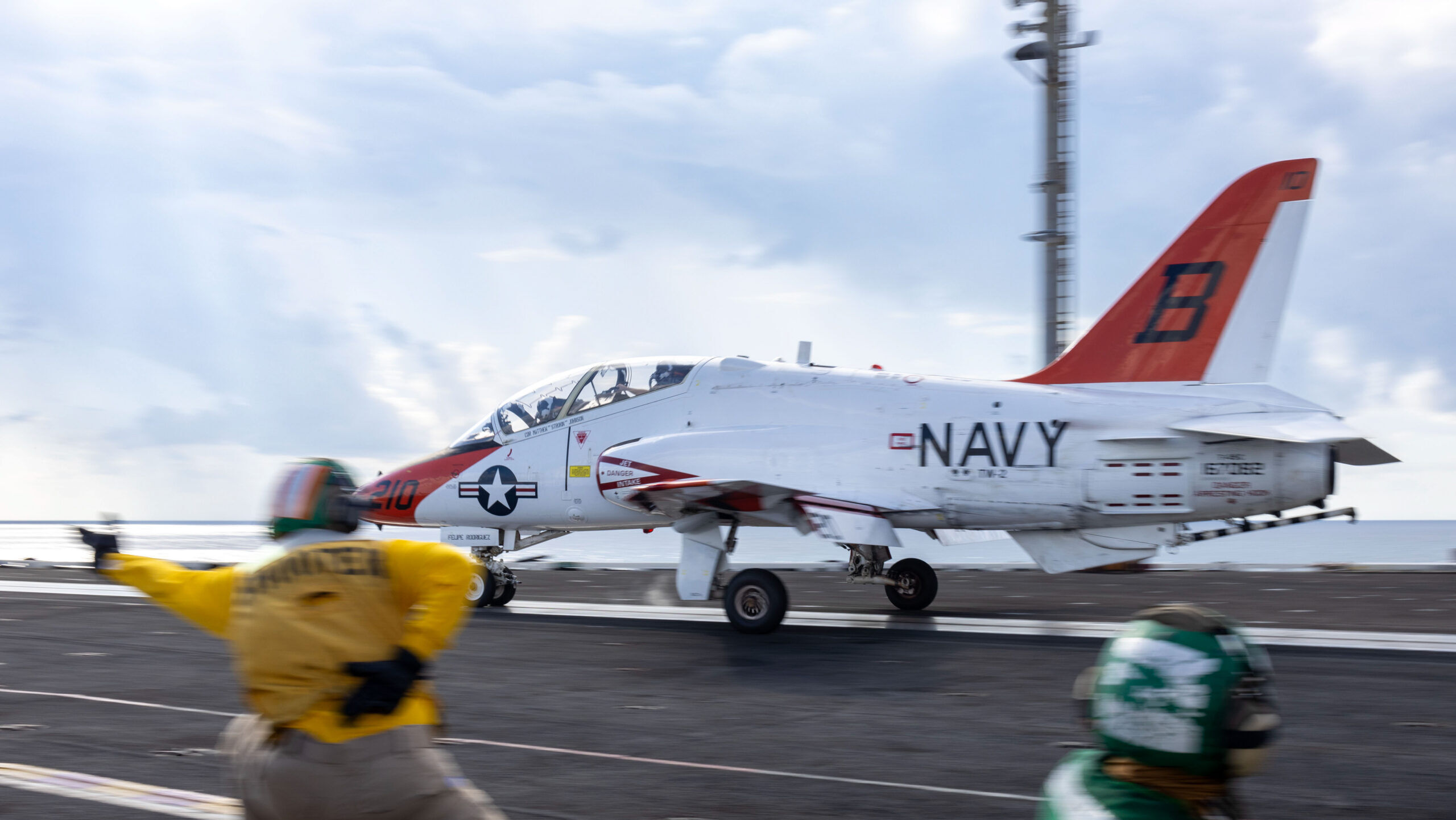
An Oct. 30 proposal deadline was supposed to settle the shape of the Undergraduate Jet Training System (UJTS) competition. It did, though not in the way anyone planned.
As Breaking Defense first reported, Sierra Nevada Corporation, the last team offering a clean-sheet design, decided it “could not responsibly bid the UJTS program under the current contract structure,” while saying it stands ready to re-engage if the Navy revisits its approach.
What remains, as far as is publicly known, is one bid from an established aircraft manufacturer: the Textron Aviation Defense and Leonardo M-346N. The Navy now has to decide what to do with a field of, effectively, one. (Stavatti Aerospace, a small company with a history of releasing concept images, says it also proposed an offering.)
What the Navy does now, more than the original competition, is the test of whether the acquisition reform it has been advertising has actually changed anything, or whether it is simply hot air. The Navy has to resist the temptation to simply hand over the award to the M-346N, and to make sure its final decision meets the criteria it has set out for itself.
The Standard The Navy Has Set
In his Nov. 7, 2025 memorandum redesignating the Defense Acquisition System as the Warfighting Acquisition System, Secretary of Defense Pete Hegseth wrote that “speed to capability delivery is now our organizing principle,” and directed a system that rewards early delivery and penalizes delay.
The Navy has taken up the message. When it stood up its Portfolio Acquisition Executives in March, the service said the new model would bring “urgency and a ruthless focus on accelerated delivery,” with leaders “empowered — and expected — to make disciplined, data-driven trade-offs across cost, schedule and performance, with a clear priority on time to field.” Then-Secretary of the Navy John Phelan was blunter at WEST in February: “The era of accepting delays, underperformance and readiness-eroding backlogs without consequence is over.”
Behind the slogans is a coherent theory built on three principles. Time is a performance attribute in its own right: Phelan said the Navy is “locking in designs earlier, enforcing disciplined requirements and consolidating authority so decisions are made by leaders who own outcomes.” Existing solutions come before new development, since the Hegseth memo’s implementing direction calls for a commercial-first approach and for considering modifications to existing options before new development. And someone owns the decision: the portfolio executive model exists to end what Phelan called “fragmented accountability.” When the Navy established its aviation portfolio executive in May, Vice Adm. John Dougherty IV said the goal was “to deliver integrated warfighting capability—at speed.”
Those are good principles. But measured against them, the UJTS situation tells a different story.
The Record So Far
The Navy released the final UJTS request for proposals on March 26, 2026, with proposals due June 29. The deadline moved twice, to Sept. 9 and then to Oct. 30. The planned award moved from March 2027 to June 2027, and the program office now says it intends to award in the fourth quarter of fiscal 2027, which runs from July through September. In May the Navy raised the price ceiling for engineering and manufacturing development from roughly $1.8 billion to $2.7 billion after industry pushback, and observers have noted that RFP changes allowed more time from contract to initial operational capability, apparently to give a newer design room to compete.
Each adjustment can be defended on its own. A wider price ceiling may produce better bids, and more time may produce better proposals. But taken together they describe schedule bending to accommodate the process, the opposite of what the Warfighting Acquisition System promises.
The reasons differ by company: When Lockheed Martin dropped out in April, it pointed to the required level of US content as a roadblock. When Boeing exited in June, it concluded the T-7A would need further development, including engine qualification work, to meet Navy requirements. Sierra Nevada’s explanation is about the contract structure, rather than the aircraft.
A reform that prizes speed ought to want to know why a competition built to attract four teams ended with one.
Some programs are genuinely hard. They push the edge of technology, depend on immature subsystems or face real uncertainty about the threat. It would be unfair to judge a reform by its first encounter with a program like that.
UJTS is not one of them.
The requirement is mature. The Navy has trained strike pilots in the T-45 Goshawk for more than three decades and knows what an advanced jet trainer has to do. The Navy has also chosen to move some of the training burden into simulation: the new trainer will not be required to land on carriers. This is not a sixth-generation stealth fighter with technology being developed from the ground up — it should be, by design, a relatively simple product.
And the cost of delay is visible and measurable. The T-45 fleet has been grounded or paused repeatedly. A service life extension program is keeping about 145 aircraft flying, and NAVAIR now plans to keep the Goshawk in service through 2040. The Navy’s own budget materials warn that without timely replacement the fleet will be unable to meet training requirements, with “a direct impact to the generation of tactical aviators.”
When I spoke recently with Rear Adm. Max McCoy, the Chief of Naval Air Training, he called the pipeline’s recent production gains “pyrrhic.” The enterprise is still short of aircraft and instructors, with too many students waiting, and his instructors are flying seven days a week to hold the numbers. Every month the replacement slips pushes more of that burden onto the Fleet Replacement Squadrons and onto Super Hornet and F-35C flight hours the fleet cannot spare.
Delay on a trainer program is easy to treat as a schedule footnote because nothing visible breaks when it happens. Naval aviation training is a production system, not a period of preparation, and it obeys the arithmetic of queues: a four-and-a-half-month grounding in 2022 helped produce a backlog of roughly 1,000 pilots that a line running at 105 percent of requirement takes years to clear. The Fleet Replacement Squadrons are where upstream shortfalls are quietly paid for in front-line aircraft hours. The value of a new trainer begins only when students start flying it, and first production deliveries are not expected until 2032. Every month added to the decision is a month added to the period in which the T-45 carries the line alone.
Deciding Well With One Bid
A thin field does not change that arithmetic, but it does change the temptations. One temptation is to treat a single bid as a reason to stop and start over. The other is to treat it as a foregone conclusion and rush. The reform standard, and the Navy’s needs, should rule out both options.
Applying the reform to UJTS now means something more demanding than holding a date. It means running a disciplined evaluation of the offers actually received, on a schedule the Navy commits to, while being honest about the risks a single offeror creates.
- Do not re-open the competition by default. Starting over to recruit a larger field would reset a clock that the pipeline cannot afford. If the Navy believes the requirement or contract structure drove bidders away, it should say so, fix it where it can, and still decide on the offers in hand. Sierra Nevada has said it would re-engage if the approach changed, and that is a question for the next buy or a bounded amendment, not a reason to restart this one.
- Do not treat a single bid as a win. One offeror removes the discipline that competition normally supplies on price and terms. The evaluation therefore has to supply it: rigorous cost and price analysis against the $2.7 billion development ceiling, hard scrutiny of the schedule and production plan and a clear-eyed look at the work still required to navalize, build and certify the aircraft. Weighing time to field honestly applies to every design, wherever its risk sits.
- Hold the date, and beat it if possible. The program office now targets the fourth quarter of fiscal 2027, a window that has already slid from March and then June. That window should be a ceiling, not a target. If the evaluation can finish sooner, the award should come sooner, and the Navy should publish its evaluation milestones so Congress, industry and the training enterprise can see whether the program is on track.
- Name the owner. The portfolio executive model puts one accountable official in charge of each portfolio. The Navy should make clear who owns the UJTS decision and hold that official to the schedule, consistent with Phelan’s call for leaders “who own outcomes.”
- Protect the decision by doing it well, not by doing it slowly. Fear of a protest is a common reason programs slip, and a narrow field can invite scrutiny of the process. The answer is a clean, well-documented evaluation against the stated criteria, not more months added to the calendar.
- Learn why bidders left, and fund the bridge. A reform serious about speed should extract the lesson from this field’s collapse for future programs. In the meantime, an award matters only if low-rate production and the transition from the T-45 are funded on time. The next budget request should treat the service life extension program and UJTS production as a single bridge, with no gap between the aging fleet and its replacement.
At WEST, Phelan told his audience that “ideas are commodities, execution is not,” and that “the weight of calculated action outweighs the comfort of caution.” The Department of War has written the strategy, renamed the system, created portfolio executives and set out the principles. What it has not yet shown is that those changes produce different decisions on a real program under real schedule pressure.
UJTS gives the Navy that chance, and the thin field makes it a harder and more honest test. The requirement is known, the proposals are in and the pipeline is waiting. A disciplined, on-time decision that neither restarts the clock nor waves the process through would show that the Warfighting Acquisition System is more than a new name. Another slip would show that the old system survived the rebranding.
The Navy has told everyone else that speed is now the organizing principle. With the proposals in hand, it is time to decide like it means it.
This is the latest in a series of semi-regular columns by Robbin Laird, where he will tackle current defense issues through the lens of more than 45 years of defense expertise in both the US and abroad. The goal of these columns: to look back at how questions and perspectives of the past should inform decisions being made today.